Three masters, three reflections:
on looking at oneself and being looked at
Imogen Cassels
I’ll start with the words of the writer, artist and activist John Berger, since he pointed out to me the invisible, inevitable spectator that every woman possesses: her self. I read the following lines from Ways of Seeing (1972) when I was eighteen, in the weeks before I went to university:
A woman must continually watch herself. She is almost continually accompanied by her own image of herself. Whilst she is walking across a room or whilst she is weeping at the death of her father, she can scarcely avoid envisaging herself walking or weeping. From earliest childhood she has been taught and persuaded to survey herself continually.
Sometimes in reading you learn something which you recognise to have always been true, and – in fact – that you realise you knew already; the first time I read this passage was one of these moments. The watchful, phantom twin of myself, or the imagined camera lens looking down from above flickered into concrete reality. My anxious habit of self-surveillance was no longer entirely paranoid; not only was it real, but it was socially conditioned. And a man, of all things, had pointed it out.
I’ve no doubt a woman has said what Berger does, here, long before him, in different phrases. I just hadn’t, still haven’t, come across it, or not quite like this. Berger was, I would tell my friends for years afterwards, the only male writer I’d ever read who seemed able to understand the experience of being a woman. Or, who understood it and was then able to draw insights and conclusions from his understanding. I’m less sure of this conviction now, though the doubt has little to do with Berger; more that gendered experience is far more constellatory than I could have supposed at eighteen, and ‘understanding’ is too imprecise a word. Better, I think, to call what Berger articulates and uses as a tool – here, and across his work – sympathy.
Berger’s sympathy is born of many things: his curiosity, razorish critical faculty, background in art historical, Marxist and feminist writing, but it also emerges – I believe – from his love for women. In seeing a woman’s own watchful eye over herself as a learned response to the male gaze, he recognises the constructive work of his own gaze there, too. Berger is good at writing about women because he is able to accept, and incorporate, his relationship with desiring women into his criticism; it is in his spirit. Take the end of his lyric book, And my heart, our faces, brief as photos (1984). ‘What reconciles me to my own death more than anything’, Berger writes, ‘is the image of a place: a place where your bones and mine are buried […] strewn there pell-mell’; ‘One of your ribs leans against my skull. A metacarpal of my left hand lies inside your pelvis. (Against my broken ribs your breast like a flower.)’ I have this page torn out and stuck up on the side of a bookcase in my living room. Even in imagined death Berger’s relationship to his partner is explicitly sexual, and without this sexuality, we suspect, there is no solace. A certain carnality animates Berger’s criticism; though this force is not the reason for his sympathy, it does – in part – make it possible. (And loving women, of course, does not save you from hurting them. At the beginning of this summer, talking me through a different crisis, a friend says something horribly prescient about the ‘brutality of the male gaze’. Which can be all the more devastating when it is also loving.)
*
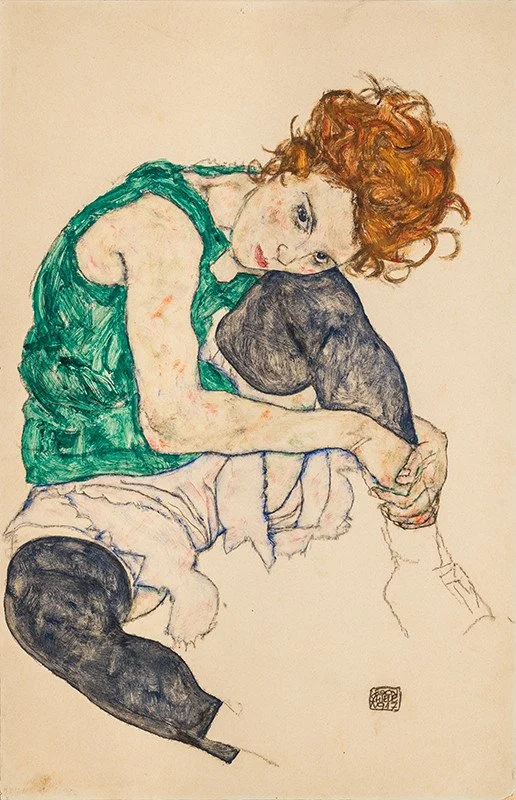
Egon Schiele, Seated Woman with Bent Knee, 1917
‘Men’, Berger says, ‘look at women’. Consequently, ‘Women watch themselves being looked at’, socialised to develop an internal, self-sufficient and self-regulating gaze, one capable of auto-evisceration in anticipation of the watchful eyes of men. The way I have learned to look at myself cannot protect me, I know, but it at least gives me the ability, however skewed, to look back at the faces of those who watch me with some foreknowledge of what they might see. Just so, the women in the nude portraits Berger writes about look back at their viewers, ‘not naked as [they are]’, but ‘as the spectator sees [them]’, doomed to ‘survey their own femininity’. They are formed not only to be objectified, but to be complicit in their own objectification; this is the way a tradition of art teaches us how to be.
In the summer I have an affair. Or, not quite an affair – something more complex, tender and risky and full of promises. But, then, isn’t that what anyone who ever had an affair always says? The man I am having an affair with loves looking at me; he wants to know everything about me, and I tell him, dazzled by my own reflection in his gaze. One of the things he wants to know about is the story of my own self-image. I have often hated my body, and sometimes still do. My face, skin, torso, limbs, hands and feet have all seemed hopeless or abject to my own eye – as my eye functions as a proxy for the Western, patriarchal vision which governs the paintings Berger talks about, and which says beauty must look one way, and not another. This pervasive vision also says that beauty is important; to lack it, as I have felt I do, is a failure of both self-hood and of gender.
But I am a good feminist; I resist the bad gaze. I know I should want to love my body – or, at least, achieve a kind of neutrality about it – and cast about for ways to do so. Some remind themselves of what their bodies do for them: how strong or functional they are, the way the body nurtures or complements the mind, how unique or unusual it is. I’ve never got much of a grip on all of these. But help does come, emerging from less obvious places. For instance: I dislike, particularly, the tone of my skin. I am extremely pale, capable only of burning and never tanning, but without the even, alabaster glow I envy in other pale women; instead, my skin is pink, mottled and uneven, especially on my limbs, and my hands and feet. Sometimes, however, there’s a point of rescue in comparison, rather than dogged destruction. I know no other women in real life whose complexion quite resembles my own – but I am familiar with the subjects of a certain painter.
I first came across Egon Schiele sometime during my undergraduate degree. Gradually, I became more familiar with his works, and their unsettling, extraordinary angularity. I loved, especially, as so many do, the portrait of his wife, Edith, Seated Woman with Bent Knees (1917), the red of her hair and emerald green of her vest setting off how delicately her face is drawn – and the uncompromisingly pale, uneven colour of her skin, with its ambiguous red marks or possible scars or bruises. Edith’s left hand is actually transparent, it is so pale: you can see the line of her ankle descending clean through it.
Schiele’s paintings should not necessarily be the source of comfort I find them to be. His subjects are worn, exhausted, and thin; they look as if they could be desperately ill, wearing their mortality on their rough, weary surfaces. They discomfit and challenge their spectators, with a violent duality: if a deathliness seems to inhabit their flung-back poses or mask-like faces, so too does a sexuality, as they look out at their viewer, asking her to go on looking.
I tell the man all this: sometimes I feel terrible about myself, but then I think of the ways in which I resemble a Schiele subject, and I feel a little better. It’s strange for it to be helpful; I don’t know what it says about what I want from myself or my appearance. I certainly don’t think it’s what Schiele meant for his work to do. Only an unexpected point of light. The man says I should write about my self-image and Schiele. I ask whether the world really needs another essay by a thin, white, able-bodied and cisgender woman about how much she hates herself. He gives a long response which doesn’t quite answer my question. Maybe I’d revise the question now, away from my own shame or well-intentioned but mis-judged fixed hierarchies of who gets to say what, when. Instead, I should have asked who, if anyone, I would be exhibiting my self-hatred for, and why – and, above all, whether there is any actual merit in curating this gallery of reflections and refractions. In the intervening months between the asking and writing this, now, I think there is: the discovery, or belief, that the tools the canon of Western art has given women for self-laceration may also, counterintuitively, be re-purposed for loving ourselves better. This is not a complete salvage, or a simple one; you can’t absolve a culture of misogyny just by claiming it. But you can observe the opportunities for self-relation it offers, catching yourself in the mirror at odd angles, in brilliant sunshine or in tears; the softening, steadying surprise of realising you might not be as alone as you once thought, that in any single image of oneself there can still be company.
It’s complicated to take solace about my own appearance from paintings of other women made by men; and it’s estranging to look at myself and see other bodies, other images, too. But to dismiss this on the grounds of it being odd is to overlook the logical conclusion of Berger’s argument, and its ramifications for the images women have for ourselves. Taught to survey a certain way by art and wider culture, we might naturally begin to model ourselves on that art, or unthinkingly reach for it as an instrument of self-relation. To categorise this as either affirming or harmful would miss the point; as I exist in the world, I feel I hardly have a choice. Likewise, in parallel, men may model us, their female partners, in the image of art history, too. Just once, the man I am seeing makes a joke, almost-harmless, about my passing resemblance to a certain painting: like a version entirely for his benefit, a private collection with one exhibit in it. It’s hard now to remember how his joke once seemed funny; all that remains instead is the lingering suggestion that men might possess great works of art, even ever so briefly, through our bodies. As for the room Berger’s subject walks across, and watches herself walking across: I always pictured it as a gallery.
**
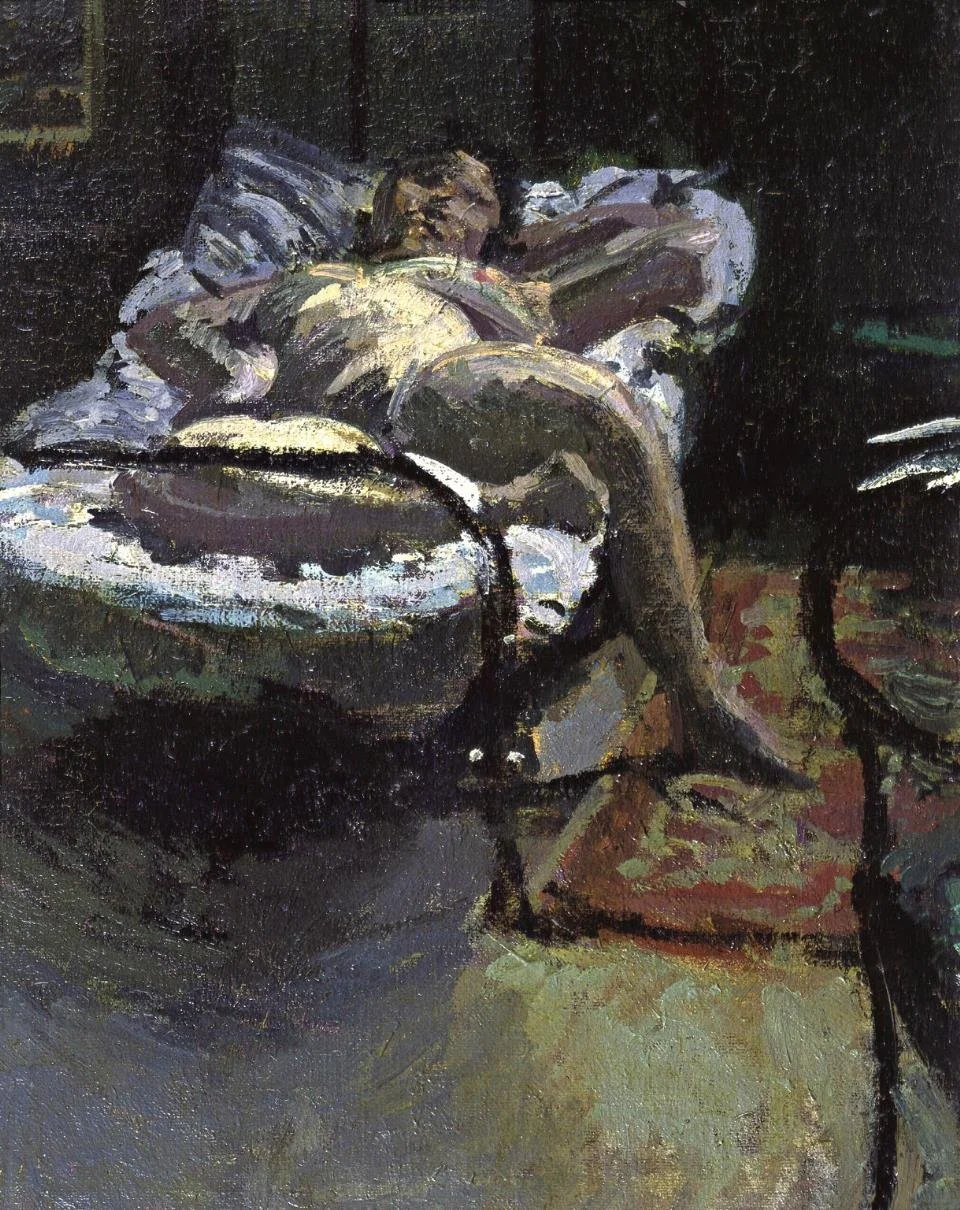
Walter Sickert, Nuit d’Été, c. 1906
Over the course of the summer, and for the first time, I take and send a naked photograph of myself to the man. He doesn’t ask me to; I do it of my own volition. In time, many more follow. He calls the first nude, among other things, ‘very tasteful’. I take it at half-midnight or so, having walked home from a night out dancing; it shows my face and torso, standing at the head of my bed, facing the window, bathed in the low, low light of the streetlamps and moon. I have to use the night sight mode on my phone to get a proper image, and the camera’s adjustment produces a strange, greenish-yellow tinge. My face seems particularly drawn and angular, as if it were a stylised painting of my face rather than a photographic record of it: skull-like, hungry and pointed. I take more photos, though I don’t send them, and they all have the same, oddly sinister, quasi-Victorian murkiness to them: the surface of my body shining out of a pea-soup fog that, the camera lens imagines, saturates my bedroom at night.
I had weighed up whether to take and send the photo earlier that evening, and felt no regret when it went off into the ether. I put my phone down and fell asleep, knowing I would wake up to his reaction. Sending nudes, I told a friend afterwards, is just like letting go of a balloon on purpose, maybe a kite. What surprised me was the response I had when I examined the series of images I had made. Looking at them I saw myself, but something about the light and my form called to mind the bodies of other women I had seen, too. Why, when examining a completely new image of myself, did I find I already had a template for it, made – painted, in fact – by someone else? ‘The nude is always conventionalised’, Berger writes, ‘and the authority for its conventions derives from a certain tradition of art’. As if all the naked women of art history were Russian dolls nested one within the other, casting out a million prismatic variations on the female body.
One particular body I am thinking of is that of the woman in Walter Sickert’s painting, Nuit d’Été – summer night, 1906. A woman is splayed back in a moonlit room. Her face is blurred, her limbs skewed about her and with one leg set off the bed onto the floor. What prompted me to think of her especially is the light that sits across her stomach, breasts, along the top of her left thigh, and which is also cast onto the floor of the room, the same muddy-green colour as the pattern in the rug, further back. Between me and her our bodies are different, and our poses: the thing we have in common is the light.
Working across the turn of the twentieth century, Sickert was German-born, raised in England, and studied with the Impressionists in France; he is recognised as an artist of transition between Impressionism and Modernism, one who – in Peter Campbell’s phrase, and Tom Crewe’s judgement – brought about a ‘tighter and darker’ kind of Impressionism in Britain. He painted in rooms in Mornington Crescent, hardly a fifteen-minute walk from my flat, setting his models on iron bedsteads and usually, Crewe notes, ‘in the light of a single window’. Maybe it’s naïve to find this detail miraculous, about the shared conditions of Sickert’s nude – which I had thought of so instantly when I saw the image I had taken of myself – and mine. Both bodies lit by a single window, on a hot night in the same corner of London, only a little century or so apart. ‘Everything in my life is symbolic’, the man I am seeing says to me, several times, throughout the summer. Well, as another beautiful woman from art history once put it: we know what we are, but we know not what we may be.
I ought to find it disconcerting to look at an image of myself and see another’s image, but find instead a solidarity – thanks, in part, to the coincidence of place and setting. Camden, summer night, one window. As if, across media both digital and painterly, women might always be inclined to look like this, in their nakedness. In Sickert’s own phrase, ‘the chief source of pleasure in the aspect of a nude is that it is in the nature of a gleam – a gleam of light and warmth and life’. Made with the images we know already in mind, or even sharing minor conditions of production, consciously or unconsciously, the nude becomes a mode which is participatory, joining in a common light, warmth and life. Here I am, it seems to say. I gleam too.
***
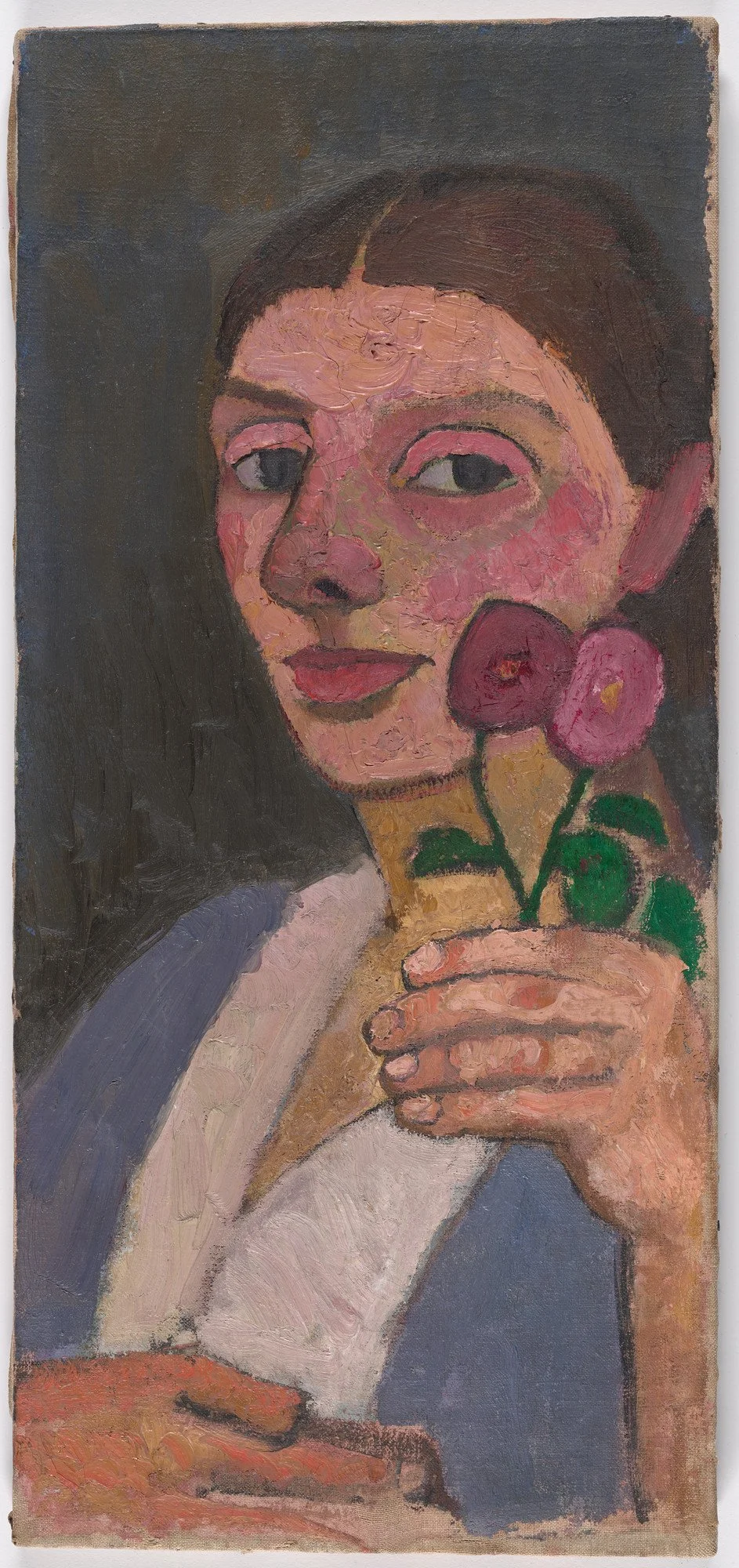
Paula Modersohn-Becker, Self-Portrait with Two Flowers, 1907
Some years ago, a friend of mine went to New York and returned with a postcard for me from a gallery there. The postcard was of Paula Modersohn-Becker’s Self-Portrait with Two Flowers in Her Raised Left Hand, painted in 1907. Back then, this friend had feelings for me, and I suspected – maybe paranoically, maybe rightly – that the portrait had reminded him of me. I was offended or unsettled by the implication, and the way it seemed to confirm many fears I have about my appearance. The red, blotchy skin, the big uneven eyes, the pointed face. It’s true, Modersohn-Becker’s portrait and I do have these things in common; her eyes are brown not blue, and her features bigger than mine, though with the same wrong or off-key angularity. I put the postcard away somewhere. I can’t remember if I even kept it; I’m sorry I can’t find it now, when I look.
This was my introduction to Modersohn-Becker. The way my friend’s desire implied a similarity between us, or my suspicion that it did, modulated the encounter. Here was a female artist I should identify with, or had been identified with, not on the grounds of our lives or practices but in the way we looked. Look has a double meaning here, where it could signify appearance or resemblance – this is how I look – and where it also means gaze – this is how I look at things. Modersohn-Becker is celebrated, for one, for being the first (known) female artist to paint nude self-portraits, including ones made when she was pregnant, as she is here; her gaze, her huge eyes turning out of the painting, look at the spectator, while the spectator looks at Modersohn-Becker’s rendering of herself. It would be simplistic to say there’s a feminist wresting of control in her decision to paint her own nudes; for every woman, the fact of her body is only that, a fact. I, too, cannot help having one. (I, too, dislike it.) Why, Modersohn-Becker’s enquiring gaze seems to ask, should there be anything notable about having, and documenting, one’s own body? On this earth, it is the first and last thing we have.
I should love my face’s redness, since it is my mother’s colouring, and I loved her, and she took it from her mother, my grandmother. I remember, in the days after my grandmother’s death in the care home, my mother recalling how the doctor had said my grandmother still looked fairly lively, even in her last days, because she still had colour in her cheeks. My mother knew better, that my grandmother was dying; there wasn’t as much colour there as there should have been. But I dislike my complexion, how my face betrays my condition when I am hot, or embarrassed, or angry, or excited. I resent my skin’s willingness to express itself on my behalf, without my permission, when I want to be colourless and unreadable.
After the end of summer, the affair – days away from becoming something else – ends. I have my heart completely broken, out of the blue, over the phone, while I am stuck in the middle of nowhere, somewhere by the coast and the North Sea. I only sleep for two hours, and call friends through the night: in Edinburgh, in Berlin, back down in London, in Baltimore. The next morning I cannot stop crying, in my brothers’ arms, then leaving voice-notes to my friends and the voice breaking. I sob and then I pause and then I sob more. I am up in Northumberland for a wedding, and when I see the bride in the church at midday I burst into tears again, confronted by how beautiful she looks and how happy I want to be. The unbridgeable gulf.
I believe there may be some women who are pretty criers, but I am not one of them. My face goes hot and red, my eyes redder, my nose runs, the corners of my mouth turn down like the dog-eared pages of a book. Looking in the mirror before the wedding, wondering how I am going to cover it all with make-up, the vision of my own face is suddenly and wildly like Modersohn-Becker’s self-portrait; the exaggerated eyes, the same map of blotchy colour. The familiarity of my own face blurred with the familiarity of a portrait, almost with the quality of a hallucination. We even have the same level, evaluating gaze: of looking directly at yourself and recognising the condition you are in. Deriving feeling and self-hood, as I have for so long that I hardly notice it, from art.
I have loved Modersohn-Becker’s self-portrait with two flowers for some time now, but finally the love transfigures into recognition, and I am willing to identify with it. A mirror of my face in crisis, one morning, and also a mirror for my heart. In the unfamiliar room where I am staying, and its unfamiliar reflective surfaces, there is solace, and solidity, in seeing my crumpled, exhausted face and still finding there a piece of art which is generally agreed to be world-alteringly beautiful. I love the way the pink and red blossoms Modersohn-Becker holds up bring out the redness of her cheeks, around her eyes, and her nose, rather than diminish it. I love her gaze, knowing and allowing herself to be so looked at, ruddy and living. The way the painter seems to understand what she is like, flushing in the truth of her own self-knowledge, and ability to reproduce herself as she is. Complicit no longer with a tradition which demands a form of beauty she cannot help but resist, and swapping this complicity for solidarity with a viewer who she looks out at as an equal.
Looking in the mirror there, and thinking about my own reflections since, I’ve been remembering two pieces of lyric. The first is from the end of e.e. cummings’s poem, ‘[suppose]’:
there is a lady,whose name is Afterwards
she is sitting beside young death,is slender;
likes flowers.
This poem has accompanied me ever since I first read it, aged fifteen or so, and now I want to ask: why should Afterwards be figured as an elegant woman, when it is a crater? The gaze cannot help recurring, in grief or crisis. But grace persists; it perseveres. This Afterwards is anonymous, almost generic, outlined only faintly by her thumbnail qualities: slenderness, flower-loving. She could be anything or one, but there is a tranquillity in her minimalism which makes a promise: hope exists Afterwards, too. There is just no knowing exactly, yet, what it will be.
The second lyric comes from the blessed mouth and guitar of Adrianne Lenker, and Big Thief. For the last year, I’ve hardly listened to anything else, Lenker reckoning with herself in the sight of others, and among the networks of the world. I reckon with my own self-hatred, and my parallel desire not to hate myself, and words from the title track of their first album, Masterpiece, come back to me. ‘You saw the masterpiece, she looked a lot like you’, Lenker sings – then, ‘like me’.
Imogen Cassels’ debut collection, Silk Work, was published in 2025. A second collection, Hares on the mountain, is due out with Tenement Press this summer. She lives in London.