Daniel Owen Interviews Sophia Dahlin | Thursday, October 16, 2025 | CoRo Coffee Room, Berkeley, CA
In this conversation, Daniel Owen and Sophia Dahlin chat about publishing, humor, community and place, form, and the influences of Sappho, Bernadette Mayer, Diane di Prima, Frank O’Hara, and others upon the publication of Dahlin’s most recent book, Glove Money (Nightboat, 2025). Prior to hitting record, Daniel had been praising the deliciousness of desserts Sophia bakes. Sophia responded, humbly, that she makes easy-to-bake desserts, which makes it easy for them to be delicious. To which Daniel argued that they’re probably only easy for Sophia because she makes them often and has therefore developed the knack…
DO: So I guess the first thing is to just ask you how this book was made? What the story of this book was, in the writing of the poems, but also in the putting of them together.
[recorder falls]
Oops, that’s fine…
SD: Boink!
DO: Um… lemme just make sure nothing happened here… Uh, the writing of the poems and then the putting of them together, working with Lindsey [Boldt] on making it into the book, I’m just curious about, y’know, from farm to table or whatever…
SD: I wanted to give her credit, because it really does feel like a coherent manuscript, but it’s not a coherent process, for me, because I just sort of write, like, individual poems. And if there are themes it’s because I’m a limited person, [laughter] right? So I have my fixations, and therefore stuff sticks together, but it can also repeat, a lot.
DO: It’s the same thing about, like, the baking, y’know?
SD: Totally.
DO: It seems simple to you, but it’s actually not, it’s only simple to you, but then you keep doing it and it’s, y’know…
SD: Right, if I want to make a thousand olive oil cakes…
DO: There’ll be like 70 really good olive oil cakes in one bound volume of olive oil cakes.
SD: That’s how people should think of Glove Money, yeah, like a stack of olive oil cakes that have been vetted. Um, let’s see, the poems are mostly from five years ago and they’re from about a five-year span, I would say, of time.
DO: You mean they were from ten years ago to five years ago or five years ago to the present?
SD: Ten years ago to five years ago basically. So if you think it’s a good book then you should be really impressed that a really young person wrote it. [laughter] There were a lot of versions of the manuscript, and they weren’t as thematically linked, and when Nightboat said they were interested in the book, they also said, “but not in this form, because it’s all over the place.” So I had to admit that it was mostly love poems and about love poetry, and edit it, take out all this other shit.
There was an accidental kind of structure given for this book, because I was working on another project with a friend, which we had to ax because of some pretty terrible disagreement that we had. But it’s interesting because we were writing a book in collaboration where we were writing “Sapphics.” It was her idea. She would write a poem, I would write a poem. And I thought that our poems would respond to each other. So my poems are often responding to hers and hers just didn’t respond to mine at all. So I had a lot of poems kind of arguing with my friend, and then her poems just wouldn’t respond to that. And then we had a big fight when she was a judge for a contest for a lesbian press. And I tried to get her to change a transphobic statement, and I think so did a lot of other people, but, um, she was very upset by this. And our friendship ended. And our collaboration ended. And she pulled a blurb from my first book. And it was really, like, total collapse. And this was someone I really loved.
DO: Aw, yeah, I remember you’ve told me this story before. ☹
SD: Ok, sorry, so that’s like where the Sapphics kind of started. But the good news is I kept, y’know, being gay, so I kept writing poems that felt like they went with the Sapphics, and some of the themes kind of bubbled back up later. So that kind of structured the book a little bit.
I do think I’m thinking a lot about translation in some of these poems, even though it’s not explicit in the way that a lot of other texts that take up the classics, or whatever, are. But a lot of the Sapphics are sort of taking on some of the moves or structures of Sappho’s fragments. And I think that happened because this friend was like, “let’s write Sapphics!” And I was like: “I don’t know what that means, but I love Sappho, so…” I’m grateful for that part.
But anyway, yeah, a lot of that work got axed, and the work that fit together fit together. At some point I fell in love with Violet, and so there was this slightly different kind of love poem that comes in sort of near the end of the book, where it’s like there’s a person but she’s not a character yet, ‘cause she’s not assimilated into my thinking yet, she’s just this sort of intriguing presence. And then because I’d had a devastating breakup a couple years earlier, we ended up pulling in some of that work for the beginning of the book. So there’s this emotional trajectory that feels very autobiographical to me, in a way. I think that my first book was fully inscrutable, in that way—there’s this emotional, kind of arc to it [Glove Money].
DO: That’s a great answer, because you also touched on most of the other questions I had prepared in that answer, so…
SD: We’re done then!
DO: One thing that seems very clear to me towards the middle and the end of the book is the rhetorical structure of argument, particularly around… I think you say against bioessentialism somewhere, not in a poem I don’t think, but… There’s a certain form of puritanism around sexuality… or these arguments with this person become such an important part of the arguments being made in the poems in a way, and it’s so interesting to hear that these arguments are with someone who’s not responding to them as arguments, and that has its own realistic dimension about the world, in a disturbing way. So, I guess the next place I want to move to is thinking about the politics of the poems and about the politics of those poems in particular.
SD: Oh gosh, yeah…
DO: Because certainly… bringing Diane di Prima and Sappho together is an interesting gesture in thinking about the politics of poetry, particularly your own politics with regards to all the stuff you’re dealing with here.
SD: I mean, I love when poems make arguments. I feel like, I kind of joke that my poetry is where I go to win arguments with Violet, and other people, you know, because I get the last word.
DO: Violet must be very good at arguing…
SD: She’s incredible…
DO: Right, she’s a debate champion!
SD: She’s a debate champion, yeah… but if you’re in love and in an argument, you’re not actually winning, you’re coming to a mutual understanding, so it’s actually a good part of our dynamic. But sometimes I don’t want that, sometimes I want to dunk on her, so then I write poems. Not really in this book am I dunking on her, but you’ll see in future manuscripts. [laughter] I think it’s one of those things where because I’m bi and I’m writing about various queer interactions, the poems have a politics that I don’t need to do anything for them to be there, because we’re just in a world where things are not built around that, y’know.
The work is kind of against TERFism and bioessentialism, in poetry, which I think is really more an issue of imagery, right? Like, what we attach to as poets, and what we sort of reify as essential in our poetry, that’s something you actually have a lot of control over when you’re working with language the way we are.
Violet actually talks about this in her first book, in the poem that’s usually referred to as “the titties poem,” [“Epidermal Ripple Pools”]. She writes about her distrust of imagery, because of the ways it can be an imposition on a kind of sexual, trans imaginary. I don’t think my book is making the same argument exactly, but I’m interested in what can you see about lesbianism, or what can you see about Sapphism, or what can you see about our egos, as human beings, period.
Sappho was first, in English, claimed by men, right?! Her poetry was translated into beautiful poetry that was appropriate for the times, that did not mention women, and then it was reclaimed. But it was reclaimed in a particular way by a particular kind of lesbian feminist, who was trying to discover the woman’s body, in poetry. And so there’s beautiful scholarship, or whatever, that I vaguely skimmed in college, I think, about the apple—the glukomelon, which I mention in the book—and it’s clitoral but it’s also like the part of the eye that you can’t touch. And it’s all really lovely, and that’s part of the history of reading Sappho—but Sappho never eats anyone out in her fragments. There is no clitoris, there is no sex scene, even. There’s just looking. There’s desire. There’s jealousy, or cuckoldry, or an echoic passion, between her and the men who get to marry the women that she loves. We’re filling in the gaps, right? So how we fill in the gaps is really interesting to me.
You can really make people angry if you don’t fill in the gaps the same way that they do, in my little community. I’m interested in that. I, in some ways, regret explicitly saying anything about transness because I’m a cis person. I think I used the phrase “trans-inclusive Sapphics” at some point, and that is catchy and solid-sounding, but I don’t think the book needs to be framed in that way—and I think that, if you do frame it that way, then it’s sort of an embarrassing claim. There’s a lot of trans poets writing poetry, no one needs me to do that. But, as someone in love with a trans woman, it’s a really big part of the way I relate to love poetry. How the body of the beloved is handled and, I don’t know, politics, did I get to politics? Diane di Prima was like a huge dyke, y’know, I mean she was bi. She made hay with her politics and she made hay with her sexuality, but kind of the other way. She focuses more on the stuff with the guys because the guys were famous. She was literally making money writing about her sex life, or her imaginary sex life, with men, many of whom were also bi or gay or whatever. So she’s a natural companion to this work. There’s just that one really hot photo of her sitting on a piano…
DO: I haven’t actually seen the photo, I didn’t yet look it up…
SD: Oh, dude… my dude…
DO: In the Gaslight, is that the name of the place, right?
SD: Yeah, I want to show you the picture [looks picture up on phone]. I don’t even have a foot thing, like…
DO: More of a piano thing…
SD: Little women sitting on things, I don’t know.
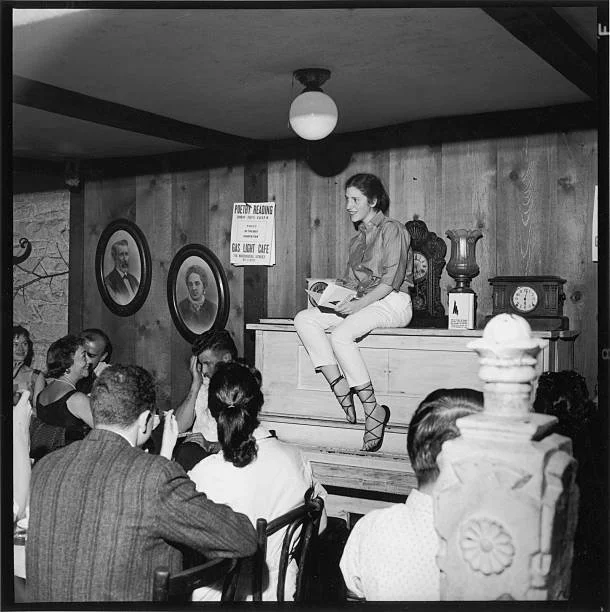
[looking at picture]
DO: Uh-huh.
SD: She’s just being such a stud.
DO: I like how the caption is “Diane di Prima sits atop a piano and reads from her collection…”
SD: I was like, those are sexy shoes to pick.
DO: Right, yeah yeah yeah yeah yeah.
SD: And she has various, y’know, lovers and their partners who they’re cheating on with her in that picture and she just knows that she’s being very foxy. I love it. That’s why Diane di Prima is in there.
DO: Is that how she fits together with Sappho?
SD: Uh, how does she fit together with Sappho? I had a gay reaction to Diane di Prima’s picture and that is how she fits together with Sappho, for me. I have a very broad sense of what a Sapphic is. People are like, “oh, are you doing the meter?” No. I am calling lesbian things Sapphic. Yeah.
DO: Capacious.
SD: Like Sappho, yeah.
DO: So I guess that leads to a question about form, which is something I was thinking about a lot in this book, because there’s clearly the Sapphic as a form, because, y’know, it’s a capacious form… but there are some discernible conventional forms—there’s a ghazal if I’m not mistaken—and various other things, and certainly a lot of use of… well, if not actually strict meter, the gesture toward the use of meter as a kind of musical or a sensorial device—so where does that come from?
SD: Meter… that just happens for me, in my work, and I like it, it’s an intuitive part. It’s like a family legacy—everyone in my family has a very musical relationship to language. I think I was trained that way in childhood. They’re all kind of writing poems right now, so I really see it.
But, formally… ok, the reason there’s a ghazal in there, is I teach these workshops, so I’m always giving my students other ways into writing and I usually do them also. So I end up experimenting more with form. I have a line, in one of the poems in Glove Money, that’s like “rhyme is a way of leaping out of your head and into the world.” I think form is very much that. So if I’m stuck in my writing, instead of writing my own work, I’ll translate someone else’s work—or I’ll try to do a formal intervention of some sort, right? Do a form. Yeah.
When I teach my workshops we’ll often read a poem and then try to extract a form from it, right? So probably there’s work in there that is, to me, actually formal but might not read that way. Like, I read this wonderful poem by Oki Sogumi where they end every stanza with the same line in some sort of pattern, and I had all my students do that and then I did it, so there’s not a word for that, but because thirty people did it in my workshop, it's a form now. It’s called the “Oki.” Who knows, they may have gotten it from someone else, I don’t know. Sappho is fun, because obviously her work had all this formal stuff which is just totally lost. Like, it’s songs, right?
DO: Right.
SD: And then it has the imposed form of being lost to time, right, so I kind of make jokes about the Anne Carson bracket thing. There are some poems with brackets but I was like, “I don’t need to belabor this, the references will be clear to those who it’s clear to.” I think when I first read that book, If Not, Winter, in college, and it, like, blew my fucking mind, I wrote a project then that was all about the gaps. And, I don’t know. Form. Did I answer it?
DO: Are you a formalist?
SD: I don’t think so… what makes someone a formalist?
DO: [whispered] I don’t know!
SD: Are you a formalist?
DO: [whispered] I don’t know!
SD: [speaking directly into voice recorder] He’s whispering “I don’t know.”
DO: Ummm…
SD: I’m not gonna let you get away with that. Whispering, so sneaky.
DO: I think I’m a bad scholar here too, because I’m like, I don’t even know what that means… I mean, I think what Indonesian poets were accusing other Indonesian poets of as formalism in the 1960s is not something that I do.
[laughter]
I do think though that there is a certain attitude towards form that is one of the strongest things that we share, in the way that we write.
SD: Mm-hm.
DO: But it’s not reproducing form at the expense of, like… are you supposed to tell people about your experience in a poem? I mean, you are, right?
SD: You can!
DO: But the thing about “you can,” that’s the hinge there. That seems to be the hinge, right? Of whatever it is that’s going on with form there. Because it’s not like a Language Poetry thing where you’re not supposed to be telling somebody what your feelings are in a poem, actually.
SD: Right, you’re not supposed to be in it.
DO: Well, I guess that’s one thing one could mean by being a real formalist… Although we’re talking sonnets, ghazals, y’know, form forms. With regards to the way the politics manifest themselves in the poems—outside of the jacket copy that positions things in a certain way—all these things are there as a personal experience… a personal experience that is not like claiming this universal truth or whatever.
SD: Right, exactly.
DO: Like you were saying before… where it almost seemed like there were concentric circles of different kinds of identities you hold that the poems relate to, and that those got kind of broader as you went. It seems to me that form makes that gesture possible to you in a way that—if you didn’t—it wouldn’t be as ready at hand.
SD: I think you can write with form in a way that draws things out… or it gives you permission to be messy in other ways, maybe?
DO: Hmmm…
SD: Maybe that’s a useful thing? I mean, I think this was true for me before I became an insane Bernadette-Mayer-head, but I think that the way she uses form is very inspirational for me. That she’s both interested in saying anything and everything and she’s also interested in saying it in these, you know, structures which she imposes. Some of which are very challenging, it’s not like she just takes them on and discards them.
DO: Right.
SD: She uses both traditional and invented structure in her work. I read an interview with her recently where someone’s like “oh you have all sorts of different kinds of poem in this book,” and [she] was like, “why wouldn’t there be all kinds of poem in this book.” And I think Glove Money is a little like, “yeah, there’s all kinds of poems.” I mean, again, accidentally I think there’s sort of a theme in here because a lot of these forms are associated with love poetry.
DO: Right…
SD: I don’t know, maybe it has this sense of hanging together because of the theme, but I think that’s just going on all the time in my work and other books are going to look like that too.
DO: Right, I see…
SD: Yeah, when I did my Midwinter Day experiments, where I try to use her experiment as a form—both times I did that, I also played “Piles of Forms, Piles of Contents,” which is a game Lee Ann Brown made up…
DO: Oh, I don’t know that…
SD: It’s cute, she played it with Bernadette and Bernadette writes about it, and that’s how I learned about it… but yeah, you have a pile of forms and then you have a pile of things you might write about. And then you draw randomly.
DO: Interesting…
SD: It’s so simple, you’re like “sonnet, about refrigerator,” right? So I played that on my own the first time I did Midwinter Day. I tried to get Paul [Ebenkamp] to do it with me and he wouldn’t. And the second time I did Midwinter Day I got Violet to do it with me, and I found out that, not only does she not write in forms but she doesn’t know what a form is. She would write like “haughty.” Like, “grand.” Y’know, like… tones? attitudes?
DO: Huh…
SD: It’s so beautiful that she had no idea. Umm… and then she got stuck writing like a fucking sestina, which she was so upset by, it was so funny. She was doggedly writing a fucking sestina. While I was throwing away her suggestions, like, “what do you mean? Whimsical is not a form!”
[laughter]
SD: We were so mad at each other but it was, like, a great night, y’know?
DO: Yeah, yeah, yeah.
SD: So even in the Midwinter Day there’s gonna be different forms. Like, in the day. I don’t know. That’s a little off-topic, but…
DO: Takeaway, form is fun.
SD: Form fun.
DO: Alright, well let’s maybe move from form to place, I guess what I’m thinking of is like, what is the relationship of place to these poems, for you? In that there isn’t really a clear evocation of a physical place. There are these gestures toward the pastoral, which have to do with the troubadour tradition, or different kinds of love poem… or, I read them at least as invoking some of the imagery of these love poetry traditions—sometimes they sound like real places, like a meadow you have been permitted to visit, or whatever, at some point…
SD: [laughter] Yeah, that’s true…
DO: But it’s also very funny in a kind of… satirical way. I guess this is a way into the question of community, different kinds of community, because… and I know this from you having shared syllabi from your classes you’ve taught that are based on intersections of community and place, right? That community is based around being in a certain place, but the idea of being a Bay Area poet, the Bay Area poetry community, and that sense of emplacedness plays out in the poems—whether it does—and how I guess, because it must, in some way, come into the actual writing.
SD: I mean I really love work that is very knit to where it is, y’know like… Frank O’Hara, obviously, a huge influence. I love that you can map his walks to some of those poems, but I actually don’t have a map in my brain, and I’m a total fantasist, so a lot of these landscapes are imaginary. There was no bridge, y’know, there was no pond or lake. A lot of these are internal landscapes. Or they’re the landscapes of poetry, right? I called Natch Natch because I was making sort of a joke to myself that I don’t know that much about nature, and yet these forms appear in my work because of language. There’s a poem about it in Glove Money. The one where “surely I’m a child of language, because I think I’m a child of nature,” right? That’s my critical work [laughter] explaining that book a little bit.
DO: So like, there isn’t. You’re not thinking about it?
SD: It’s in there, but not so terribly… because while I say it has an autobiographical arc, it’s not nonfiction. There’s imaginary relationships and circumstances, also. If you ask me who’s this girl in this poem, it might be a real girl or it might be a way I can imagine relating to someone. It’s just a very intersected fantasy and reality. Like Ashbery, everything feels a little half-dreamt, right? Or all dreamt? I don’t know, I feel like there is a difference—when someone is writing… they’re really writing because they’re trying to create a portrait, I mean an accurate portrait of a place, or like a geography…
DO: Like some of Bernadette’s writing…
SD: Yeah…
DO: That’s very interested in a certain kind of fidelity to an almost empirical experience of life.
SD: Exactly. When I did the Midwinter Day for instance, then it’s like that. Then we’re crossing real streets in the poems. But in this work, there’s an imaginary landscape, for sure, in a lot of it.
DO: So then how does that relate to the notion of being part of a community that’s based in place or circumscribed by a place?
SD: Well I think I have other work that is more… rooted. Like you get a couple real names in this book, but not that many, right?
DO: There’s a fair amount…
SD: Oh, well, to me it seems like nothing—you’re gonna get way more when my other manuscripts finally find their places in the world.
DO: So they’re… kind of gossipy almost?
SD: Yeah, there’s more real conversations, there’s more real portraits of people…
DO: [flipping Glove Money open to the poem “At the Changi Airport”] Now this is a poem about a real place.
SD: That is a real place, yeah.
DO: And it goes into a different real place…
SD: No, an imaginary place…
DO: It goes into an imaginary place…
SD: It goes into two imaginary places…
DO: Ahhh…
SD: It goes into living in a giant’s mouth and then it goes into the way kids draw their houses, not as their real houses, but as imaginary houses. Great example here.
DO: The title just gives it away: that is a real place that I’ve heard of.
SD: This is “At the Changi Airport,” and that is where I was, and it was such a weird landscape that I tried to write about it, but as you see I quickly, um, entered a giant’s mouth.
DO: I blame the ham toast from Paris Baguette, that’s what brought on the, uh…
SD: Yes. And you know, I think that the original draft of Glove Money had more about my family. It had more about my brother. My brother is like an on-off incarcerated or unhoused man, um, and a poet, a great writer. Samuel Palos Kramer.
And, my family, growing up, was exactly the kind of family that you learn how to draw. Like father, mother, three kids, right? We did not actually have dogs, or cats, at the time, but we might as well have, because we were that, y’know, perfect. But it’s like when kids learn to draw houses: first of all you draw a chimney with smoke coming out of it, which, y’know, Southern California, no, that’s not a thing. And second of all you don’t draw anything else. You draw white space or you color in the whole sky blue, if you’re an ambitious child, or you do a stripe of blue at the top, right? If you haven’t learned about perspective yet. But you don’t draw other houses, or you don’t eventually draw my grown-up brother living on the streets or rooting through our neighbor’s trashcan and getting trash all over the driveway because he’s currently out of his mind and looking for recycling, right? That wouldn’t be in the picture. Obviously. So, I wonder how this poem reads out of the context of the other work…
DO: It’s definitely noticeable that it’s a family poem.
SD: Yeah…
DO: Without a lot of other family poems. But I think because of the variousness throughout, it’s just another dimension, which I feel like does something that nothing else is really doing—which is, I think, a strength in the book.
SD: But you’ll notice there’s no one’s name in that poem. I do not have to say which of my friends is a bad kisser, right?
DO: Right.
SD: Yep. There’s a lot of good reasons not to write community in place-based poetry.
DO: Just the ham toast from Paris Baguette.
SD: Yeah.
DO: What about puns? What do puns do for you? There’s tons of puns…
SD: [laughing] Puns are also part of my secret family culture.
DO: Oh really? Interesting…
SD: Yeah, we all make puns. I love puns. Puns are also a formal intervention. They’re a way of leaping out of whatever you think you’re saying or trying to say.
DO: Like you say about rhyme, right? What’s that line again about rhyme?
SD: Uh-huh, “rhyme is a way of leaping out of your head and into the world!”
DO: Huh, I just noticed that “She’s Got a Habit” is a pun…
SD: Yeah! No one would ever get that, but like… I talk about the movie in the poem…
DO: Yeah, true…
SD: …and I still don’t expect people to get that.
DO: There’s also something that’s really noticeable, that’s really striking, about sound… so many of the poems are very sensual, y’know, there are love poems, erotic poems—and so much of the way that you put consonance and assonance together makes me very conscious of the movement of my mouth in saying these words that has a real… sensuality to the way you say the things out loud.
And there’s a weird texture it makes with the pun, where the poem is both coming out of your head, but also going deeper into your body—in the context of all this other language which is making you more conscious of being embodied. They're bringing you out of yourself, but at the same time this other kind of music in the poems is making you more conscious physically, and sensuously…
SD: Yeah, I like that…
DO: So, how?
SD: So, puns are projectile, right? They shoot you out of whatever you’re doing and into something else. They trip you up. But that’s also a way of becoming sensorily aware, right?
DO: Right. And they’re multiplying…
SD: You have to be aware that you’re standing on imaginary ground. That’s one way to connect it. So, we just did this exercise in my workshop yesterday, which is something I really enjoy doing. It’s trying to replicate the thing in Alice in Wonderland where Alice tries to recite poetry, but the poems that she knows by heart are coming out as different poems. It’s like a nightmare, y’know? So I wanted my students to have that same nightmare. I had them do a thing where they tried to get their classmates to write their poems. Like, I’ll describe everything that I did to write my poem and then you try to write it. But they can’t quote themselves. So then their classmate obviously writes a totally different poem. Though often with weird echoes, because we’re all not terribly different, but, um… it’s a really fun exercise.
But, puns, there’s like an estrangement that’s constantly available in language. And I like reaching for that estrangement in ways that are obvious and familiar and hokey and punning, right? It’s like how we were taught about humor, and also about language, when we were children. We’re about to have kids and raise them, Dan, and you’ll notice child jokes—like jokebooks or whatever—it’s 100% puns. Popsicle sticks, they’re all puns. And you think that that’s what jokes are. And then you grow up and everyone’s like “eeuuhhh.” But I like the obvious weirdness of doing that. And you know sometimes it just leads you to a different image. Like, I have a poem called “God’s Peed.” Somewhere.
DO: Yup, it’s right here. [points to book page]
SD: Yeah. [laughs] And it’s like yeah, now we can think about the rain. You need to go fast because it’s raining. God’s peeing all over you. You know?
DO: There’s a line in this poem, “She’s Got a Habit”—or, a couple lines—that I will read to you now.
SD: Ok.
DO: “…I sing / ‘You’re going to lose that girl’ and I am / John Lennon. I’m that girl. / I’m the schmuck receiving warning, // and I’m the predatory lesbian / promising oral understanding to the girls at karaoke.”
SD: Mm-hm, all true.
DO: Right, see…
SD: Autobiographical.
DO: I feel like that kind of concretizes a lot of the different formal moves that are being made, like a theoretical enunciation of them or something.
SD: Totally. But it’s also like, if you’re just singing a song in your kitchen, if you just pause for a moment and think, “well, what emotional functions is this providing for me,” it might be a lot more than you think. [laughs]
DO: Right, but it’s also this public property or something, which is a poem, or language, or puns especially, where the output of the thing is opening up more. There’s more than you thought was there in the first place, because now it’s meaning all these other things than the initial language on its own, if it wasn’t a pun, would have meant.
SD: Yeah, it’s explosive…
DO: Yeah…
SD: And stuff sticks. And you’re like “oh, shit.”.
[interlude, Sophie goes to get water]
DO: Ok, cool, so, narrative! You were talking before about how there’s kind of an arc to the book that was made in the editing process.
SD: Yeah.
DO: And some of the poems are quite narrative, others are quite not-narrative, and I’m really curious—what is narrative doing in this book?
SD: Ah, good question. Well… my first book was really sound-oriented, I’d say, before anything else. And if you were to read my juvenilia, you would find it to be 100% sound-oriented. Like, without deducible meaning, in most cases.
[bee buzzes around Sophia and Daniel’s heads]
DO: Think bitter thoughts, bitter.
SD: Okay. [addressing bee] You… you get to fly and I never do. Is it working?
DO: Yes.
SD: Okay. Glad I have so much bitterness I can draw on… Ok, I mentioned a terrible breakup earlier in this interview—it was a terrible breakup, it was a terrible relationship, and then, you know, you have to be in a decent relationship to have a good break up, don’t you think?
DO: I think so. That’s been my experience.
SD: [laughing] It was a terrible relationship and a terrible breakup and I could not write… I had to start putting parts of my life in my work, because I couldn’t think about anything else. Because I was thinking very hard about my life for like… um, the first time?
I think I’d been interested in narrative earlier in my life. Because y’know, you’re a kid, you read stories. I love novels, I’m trying to learn to write novels now, all of that is very compelling to me. But how I got really into poetry was by kind of dissociating from narrative—from imagined narrative but also from, y’know, me. There’s no me, there’s just sounds. So while there’s a little bit of life happening in Natch for instance, it’s just a sprinkle, right? And then there were some years where if I was going to write then it had to have people and it had to have me. And I wrote a lot of really terrible work learning how to do that. I sort of joked that I was writing murder ballads for a year, as recovery from a bad relationship.
DO: That’s a great form.
SD: Yeah, it is. They were not actually murder ballads, they were just dark [laughing] poems with people in them, kind of. So, yeah, I think that really changed my writing. By the time you get to the work that appears in Glove Money, it’s more capacious and there’s space for sound and fantasy and humor again.
Some of the early poems have this kind of like, “I have just healed enough from these wounds to start dating again, to start being open to other people again” kind of feeling. So that, I think, is how in my life I got to narrative. How it functions in the book, I don’t know. I think, as you were saying, there’s an emotional arc that kind of happened by accident, but you can probably edit for that in anyone’s work that contains elements of the self, right? That’s how you tell a story, you just take away some parts, and you focus on one thing—so that’s what Lindsey [Boldt] helped me do when she was editing it.
DO: How much difference in time separates these poems from the poems in Natch?
SD: That’s a good question. I mean, Natch is my first book so it’s really like my first five books. The first draft of it that I ever put together, there’s maybe six or seven of those poems that ended up in the final version. For years, whenever I wrote something that I liked better I would just change it. [laughing]
DO: Was that from MFA time?
SD: It was before and then also MFA. I turned in a version of Natch for my thesis and didn’t put in anything from before the MFA, and I told my advisor that and he’s like, “there’s more?” [laughing] Y’know, like, “what do you mean? Why isn’t it all here?” Because I didn’t write that here.
Then there’s a little rupture of maybe a year when I didn’t write anything that anyone could ever read. Murder-ballad-training-myself-to-write-about-life year. And then I started writing the poems in Glove Money. Probably separated by, like, a year. The poem “Glove Money” was written by the time Garrett [Caples] and I were working on editing Natch, and he asked, “do you have anything that you’ve written recently that you really like that you want in it?” So I sent him this earlier draft of “Glove Money” and he really liked it.
DO: The poem?
SD: Yeah, the poem, sorry, the first poem in the book. [in a voice of putting on airs] The title poem.
DO: What’s that word?
SD: Uh, the eponymous poem?
DO: Yeah.
SD: I love that word.
DO: Yeah, me too.
SD: I do use that as much as I can. So I sent him the eponymous poem, and he really liked it, and then he asked me for a final cut of the book, and I think I just couldn’t tell if it fit or not? It felt like it didn’t, honestly, it felt like a totally different book.
DO: That would be what my editorial instincts would say.
SD: See, this is why I need other people to edit my work. I feel like seeing the manuscript, seeing the book, that’s my challenge, that’s my blind spot… I had a lot of fun doing my MFA, but I don’t need line edits.
DO: Yeah, totally. A lot of poetry editing—in my experience of poetry editing—it’s not about line editing, it’s about… shaping something into a book and making a whole thing, and not this small thing.
SD: Yeah. So I showed it to Brandon, to Brandon Brown, who’s, you know… amazing. And, he was like, “this is a great poem, and it does not go in your book.” And I was like, “I know!” I hadn’t told him what was from when or whatever, but he basically found the poems that I had given Garrett more recently and he was like “not that, not that, not that. These are doing something totally different.” And I gave the manuscript to Garrett, and I was like “it doesn’t work with that, it’s like this.” And he read it and he was like “yeah this is really good, what did you do? How did you learn so much about editing?” And I was like, “yeah, Brandon read it.” [laughter] I just needed someone else to be disciplined enough to be like, “you want this poem to be in your Spotlight book, but it doesn’t go.” And I’m glad. I’m glad it’s not there. Because it wouldn’t have made any fucking sense. And it introduces this book so well.
DO: I mean, it’s hysterical.
SD: Thank you.
DO: When I used to go to more poetry readings than I do now, it used to always occur to me that like “wow, we’re all just like really bad comedians.”
SD: Some of us are really good comedians.
DO: Yes. But, most of us…
SD: And those people often quit and do something else, like comedy.
DO: Something more profitable.
SD: Right. [laughter]
DO: Exactly. I’m curious about what that was like, having a City Lights book?
SD: It was amazing. It was so cool. It was my first book, but again it felt like my fifth, because I kept changing it.
DO: Well, you had written a lot. And published things in little different places by then, it wasn’t like you were some young person who just kinda shows up and…
SD: No, [moving closer to voice recorder] I was very young, and I continue to be very young, um… sort of shockingly young. [laughter]
DO: If you get closer to it, it will be more true. [laughter]
SD: Um, no, yeah, it took a frustratingly long amount of time for my first book to come out. And I think that’s normal, like, honestly, I know so many great poets who don’t have a book out yet. It’s just weird how it doesn’t come together, for a lot of people. It didn’t come together for me for many years, which is why there were so many drafts of Natch. And it is hilarious that the press that did want it is City Lights, because that was the most aspirational submission that I made. And it was really awesome, and Garrett was great to work with. He was very laid back about it.
DO: Alright, so I got two concluding questions, if that’s cool?
SD: Mm-hm.
DO: So these poems you wrote five years ago, right? How do they relate to what you’re doing now? And how are you feeling about them now, with this distance of time and now that they’re this, like, printed object that people are reading?
SD: Yeah, umm… I still really like them. Very, very recently I have been focusing on editing other manuscripts—there’s a pandemic manuscript, which is also when Violet and I moved in together, and my world became very deep and very small. It’s just kind of, like, me and her writing poems in the same room every day. About each other. [laughing] Or about things that we’d been talking about, like, all day. So that’s one manuscript that, I would say, is very rooted in time and place and real people and nonfiction, because circumstances were overwhelming, right? And then there was the sort of very big impact of Bernadette Mayer on my life, and there’s a manuscript that’s more influenced by her—it has the poems from the Mayeresques chapbook and stuff.
DO: It was that recent, huh?
SD: I read her here and there, y’know. I’d read The Sonnets, like, back in the day, but I didn’t do a deep dive until Violet did a class with Kay [Gabriel] and got a bunch of the books that I hadn’t read, and then Bernadette died and everyone was sharing her, y’know, the stuff you couldn’t buy—PDFs were circulating, so I ended up reading dozens of her books all within one period of time. Yeah. I taught her work, then I did the Midwinter Day exercise twice, so I have two midwinter day manuscripts that are very also time-and-place, and I also have this work which is trying to write about the unspeakable difficulties of loving someone who is an addict and who is being actively chewed up by a system which is not equipped to provide for him. And then there’s a real dreaminess to it that is the answer to how it’s bearable, I think? I don’t know.
One difference between the love poems in Glove Money and later love poems is that… I’ve been in love with and in conversation with the same person for many years. So, in this book Violet is—as she has referred to herself, and I said this in the Nightboat interview—she’s like a pair of eyelashes coming over the horizon, like she’s sort of appearing in flashes of perception, but it’s like, this is too much to look at all at once. But in later books, we’re in conversation. We’re talking to each other, she’s a person. And I think there’s also more explicit conversation with other people, including friends of ours and, a little bit more of that, like, communityness, because this is also a period of settling into the Bay and being a poet in the Bay.
DO: Oh, it is, huh?
SD: Yeah.
DO: Biographically?
SD: Yeah, because I moved back here after being away, and everything had changed… you know, friendships are slower here—it’s not like New York or wherever it is that people make friends quickly, it’s not our 20s. [laughing] It’s like, y’know, people I’ve even been friends with before, it felt like it took awhile to sink in and deepen again and get involved with reading series and stuff like that—these things that you know are very important to me. Like being a Bay Area poet and writing in community, these might be more evident in the work since Glove Money.
DO: Yeah, interesting. Because my impression of you as a person, more than as a poet, since I’ve lived here is that you’re at the center of the scene or whatever.
SD: This is me in my full adulthood. But me in my youth was more of a little will-o’-the-wisp. Like I’d probably always been an extrovert, but a pretty dreamy, spacy child. And then, you know, you move here and you go to readings.
DO: Have you always had so much energy?
SD: Well, we just had coffee… [laughter] so you’re seeing me in a particular moment.
DO: No, I meant in a… in a broader way than you’re talking right now. You seem to be always making things and hanging out and, y’know.
SD: Yeah. Well, strategically I’ve never worked a full-time job.
DO: That helps!
[laughter]
SD: Teaching is really good for me, because it’s condensed. You can still do a good job and not have it be your whole life. I have a lot of energy for other people. And I have a lot of energy for reading and writing. Because those are my favorite things.
DO: See, again, this is just what we were talking about with the olive cakes, man. [laughter] That’s basically the same thing you’re saying now. So it’s gonna be easy, y’know, or it’s gonna…
SD: Or it’s gonna be good, hopefully.
DO: Right, it’s gonna be good. Because it… maybe it’s not easy. Is it easy?
SD: Sometimes it’s easy. Yeah, yeah, sometimes. You know Dan, I’m appreciating how many of the conversations we’ve had in non-recorded contexts have to do with our practices. Because I’m like, “you know all this shit.”
DO: Yeah, I just want to get it on the record.
SD: Yeah, I’ll put it on the record, but, as you know I write a lot of drafts and most of them I throw away, right? But it’s easy because there’s a return. Because I do it all the time. So, sometimes it’s very hard, but you’re probably not going to read that work, because it didn’t, y’know, happen. Y’know, I’ll feel like a fucking genius because the best poem I ever wrote up to this moment might have just come out quickly and without much forethought, but obviously…
DO: Right, because you’re always working on it…
SD: …it’s because actually I’ve probably already drafted it in some form before.
DO: Right, it’s that 10,000 hour thing or whatever.
SD: Yeah.
DO: My final question for you is: what’s next for Sophia Dahlin?
SD: I love that question... I am going to learn how to write with a baby. And if I can write or am interested in writing with a baby. Violet suggested we do a Piece of Cake type exercise. That sounds really fun but not, like early infancy. I feel like that’s later, when we’re actually getting some sleep. We’ll see. Maybe something more fragmentary. Yeah, that’s next for me. A whole new form. A whole new formal constraint... What’s next for you?
DO: Me?
SD: Mm-hm.
DO: I don’t… I don’t remember.
SD: “What’s next? I don’t remember.” Ha. I forgot the future too.
Daniel Owen is a poet, editor, and translator between Indonesian and English. Recent poems have appeared in Chicago Review, Long News, and Works and Days. Daniel's translations from Indonesian include Afrizal Malna's Document Shredding Museum (World Poetry Books, 2024) and The Running Century (Reading Sideways Press, forthcoming 2025). He edits and designs books and participates in various processes of the Ugly Duckling Presse editorial collective.
Sophia Dahlin is