Other Obsessions:
Little Prayers, Numbers
Margaret Saigh
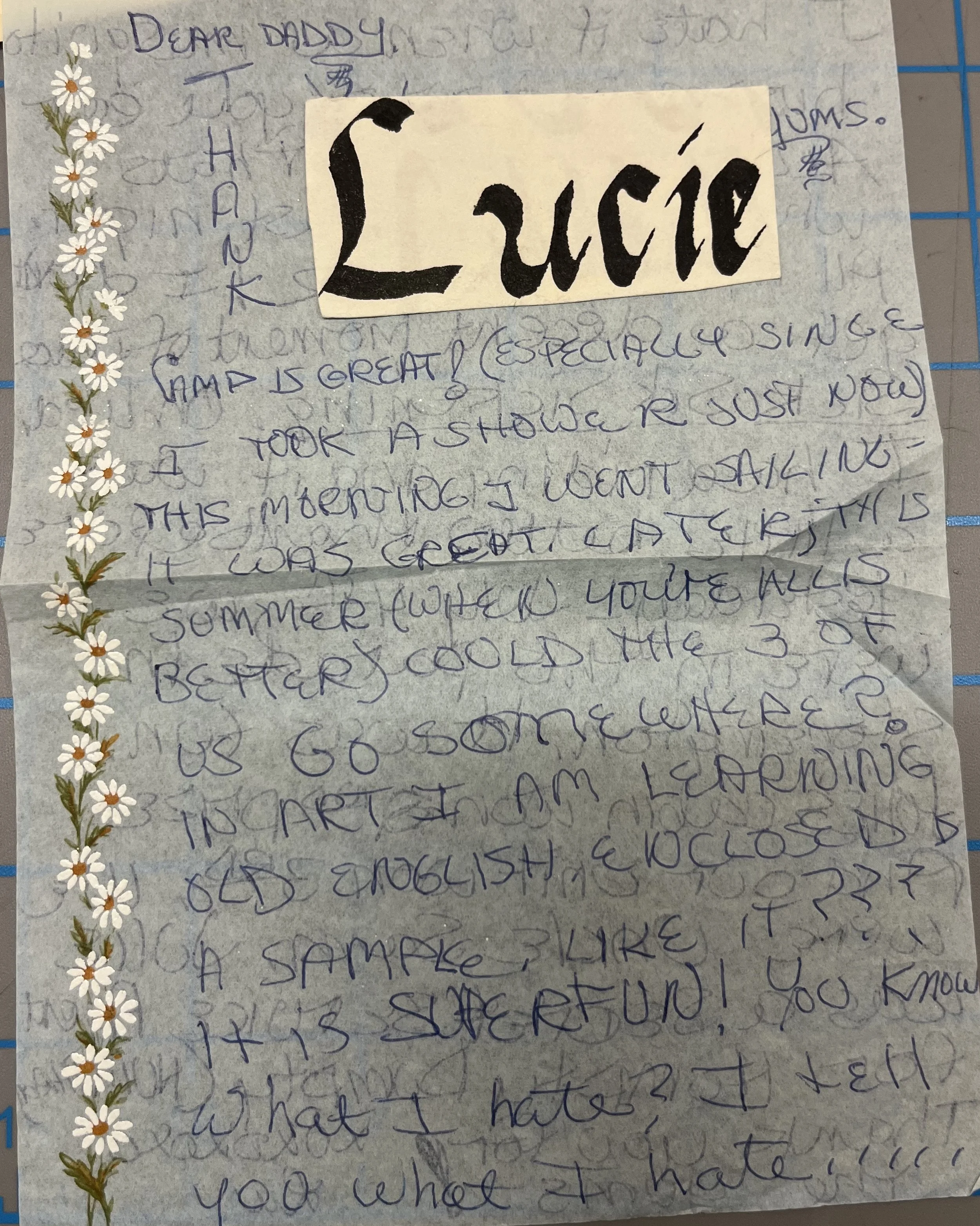
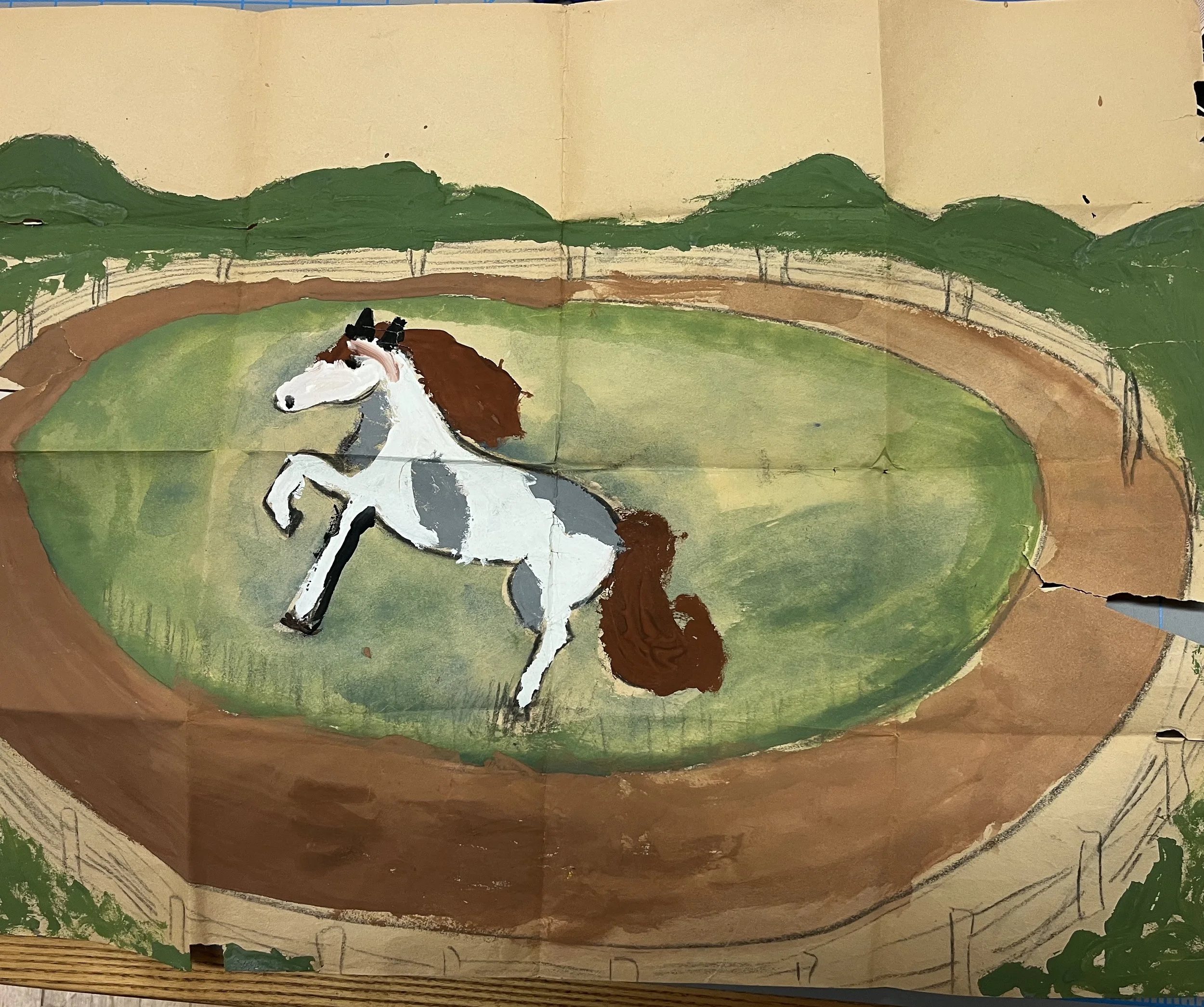
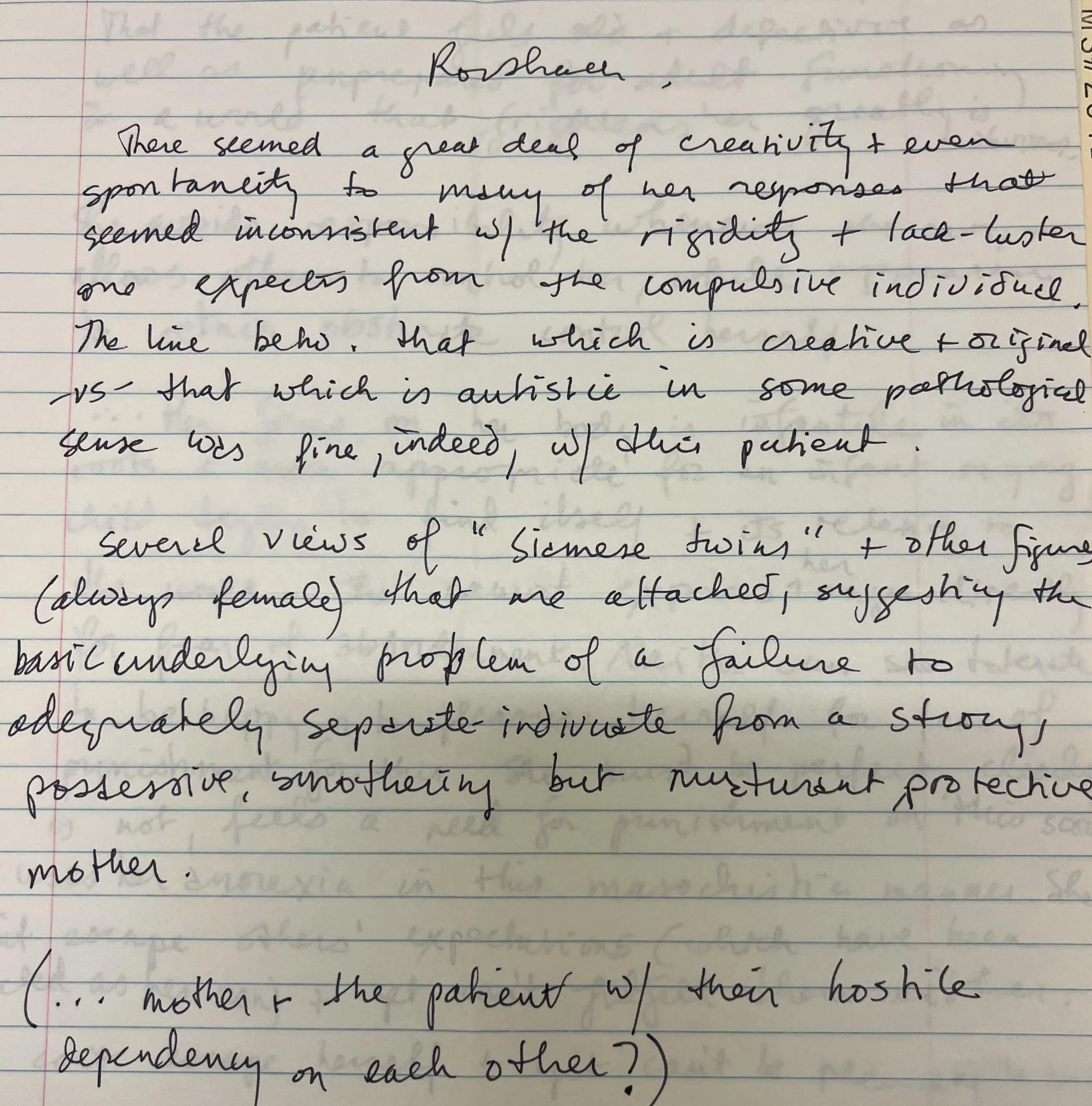
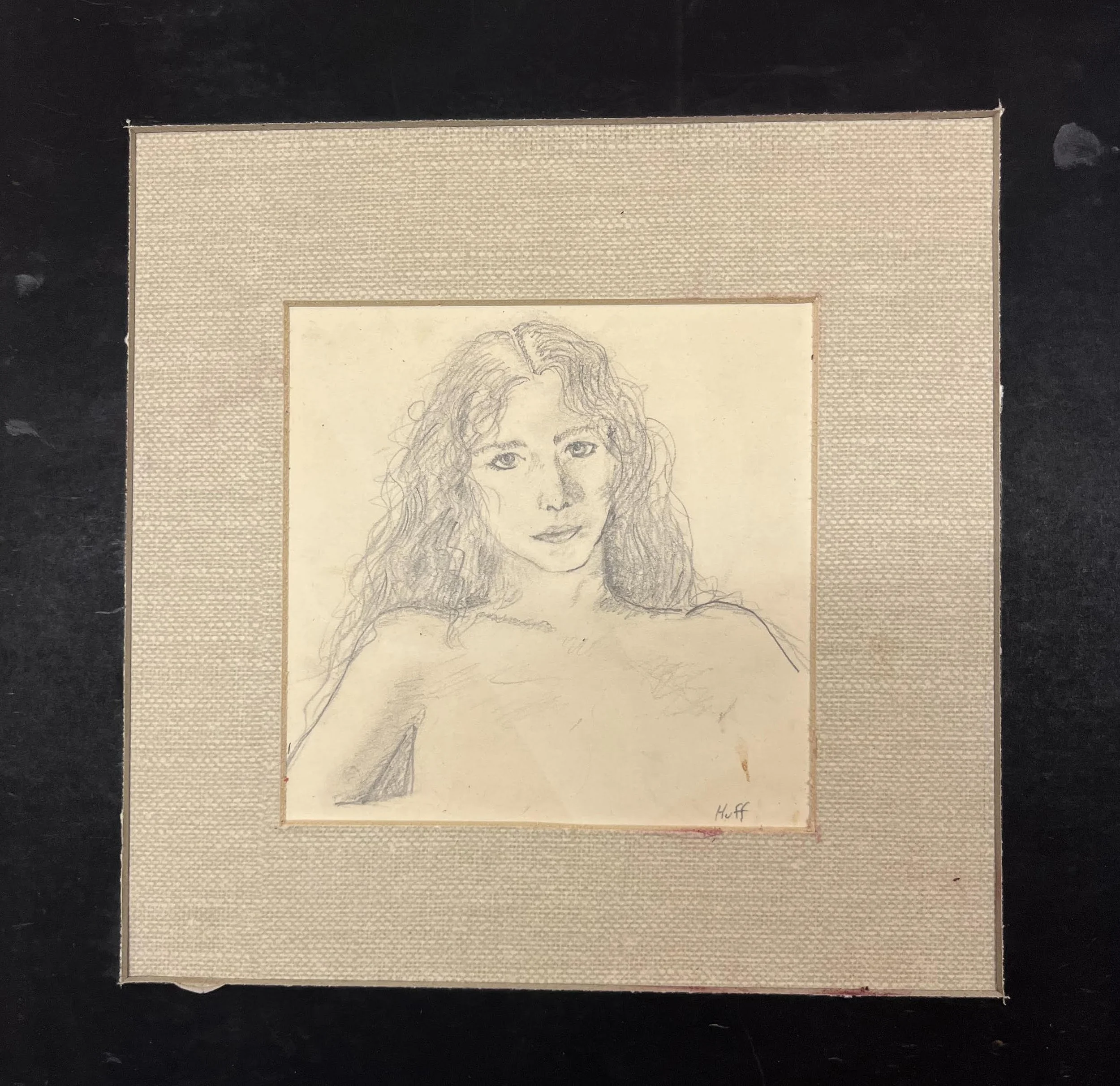
Lucie Brock-Broido’s father addressed her as ‘Lockett.’ She sent him samples of calligraphy she’d practiced at camp—her name—on translucent blue stationery dotted with daisies along the left margin. A painting of a pinto horse in the center of a large circular pen. A sketch of Lucie by her high school boyfriend, Brian. A 1974 letter from a friend—Maxine—claiming she loved Lucie more than “strawberries, Joni Mitchell, air conditioning, and chocolate chips.” Two handwritten pages of “diagnostic impressions” from a psychiatrist. She saw siamese twins in the Rorschach test—an “underlying problem of a failure to adequately separate- individuate from a strong possessive, smothering …mother”; Lucie’s completion of the Yale-Brown Obsessive Compulsive Scale. A photo of Lucie in front of Yeats’ grave. A photo of Lucie with her prom date. An appointment card for Planned Parenthood. Baby teeth in an envelope.
Lucie Brock-Broido grew up in Squirrel Hill, a lush, tree-lined neighborhood in Pittsburgh, PA. I also lived there, from 2019 to 2025. I often walked my dog to Maynard Street, the location of her childhood home, passed by Solway Elementary, where she attended primary school, and sat on the steps of Sixth Presbyterian Church, imagining her as a high school student, smoking cigarettes and watching the buses pass, strands of wispy blonde hair blowing in her eyes.
I first encountered Lucie’s work in a graduate lit class at the University of Pittsburgh. We read her third collection, Trouble In Mind. The first lines of hers that really stuck with me were from “The Insignificants”:
I’d wanted once to love
your mouth on mine, its ether
Gasping through a gauzy
Metal mask; I’d wanted to be breathed and taken
To an actual, like an addict floating on a desperate tiny river
Of open iridescent pigeons’ wings and the floating poplin
Smocks of dusky, spoony girls.
As if I could breathe still.
The use of “actual” as a noun. The surprise reveal of the river, composed of wings and poplin smocks, nothing as ordinary as water. Her ability to unfold an image to the point where the reader had forgotten the sentence’s initial subject. This is typical of Lucie’s writing: the speaker’s voice is elliptical and fragmented across line, as I first discussed here.
Another stanza my friend K. and I puzzled over was from “Fragment on Dissembling”:
Once, to make of nothing
Something, was divine.
To have made
of something
Nothing, was sublime.
Nothing, something, divine. Something, nothing, sublime—this was how I parsed the poem in my journal. Now, I hold my open palm, then grasp the air for divinity. Now, I grasp the air, open up my palm for sublimity. Since my initial encounter with Lucie’s work, I’ve learned much of her biography, visited her archives at Columbia, and spoken with former students and close friends. Her parents divorced when she was a toddler, her father died when she was twelve and at sleep-away camp. She struggled with anxiety, OCD, and anorexia. With this knowledge, I cannot help but read the last three lines as speaking directly to the common blight of American girlhood: that beauty is something made from nothing, from a hunger.
Lucie often referred to her anorexia—describing herself as a “hunger artist”; in her debut collection, tellingly called, A Hunger, she writes “after the anorexics have curled / into their geometric forms” (55); in the early 80s, a psychiatrist described Lucie’s mental state in the following way: “[She believes] she must be perfect, clearly is not, feels a need for punishment on this score + uses her anorexia in this masochistic manner.” Lucie’s punishing obsessiveness was clear across many archival files. In journals, on doctor’s office notepaper and museum pamphlets, Lucie wrote and rewrote the same conclusion over and over again: that she could not continue a decade plus relationship because “it’s a virtual certainty he’ll disappoint me”; I handled the photo of the man in question with blue latex gloves on—though their relationship seemed to end in the early 2000s, she hung onto his photo, a manuscript he inscribed her, as well as stacks of his letters. Timothy Donnelly, Lucie’s long-time friend and colleague, described this magpie-like behavior as characteristic of her. She held onto everything. Timothy recalled the feeling of complete overwhelm upon entering her Cambridge house after her death; the sheer clutter and excess: stockpiled bottles of a particular shade of Clinique lipliner, a specific jar of olives—long expired, every draft of her four poetry collections. Timothy observed that Lucie stockpiled the things she treasured because she feared losing them. He said that “it was always the thing she was mastering, the loss of people.”
My interest in Lucie has only intensified since going through her archives. I so deeply identify with her neuroses: wanting to say the right thing in just the right way, struggling to accept loss, using food to control and punish herself, the suppression of gut feelings, how deeply and intensely she felt for the marginalized and cast-offs of society—Kaspar Hauser, Tookie Williams, Ricky Ray Rector, Jessica McClure, Anne Boelyn, zoo animals, livestock, Emily Dickinson. She and I lived like this: the half-life of suffering stayed in our bodies for much longer than is perhaps normal: on the verge of tears but never breaking down. “A poem is troubled into being; it’s not a thing that blooms but a thing that wounds”—Lucie said in an interview in Bomb Magazine, and her life seemed to imitate this art. All loss is intolerable loss.
Much is celebrated of the artist with exacting and high standards for her work, and, by extension, herself. Exactitude is especially necessary in poetry, which is an economic form, even at its lushest. Tracy K. Smith, one of Lucie’s former students, recalls Lucie telling her: “You’ve mixed all the ingredients together, but now you must roll them out and cut them into pleasing, symmetrical shapes. Like sugar cookies.” When I write a poem, I write it quickly, put it away for weeks, then return and cut it into pleasing shapes. When the poem fails to achieve a pleasing shape, I am transfixed into a near dissociative state. My inability to write my way out of the failure is too painful to face.
When I scroll the internet, as I inevitably do in these blackout periods, I find myself wondering how Lucie would react to the rabbit holes of niche content I encounter: for example, a genre of video—ranking every death row meal—where Youtubers rate famous serial killers’ final meals. Another thing I admire about Lucie is her ability to find the poetry in the crass and churning mass media ecosystem. “Angels really exist and thousands see them” reads one photocopied tabloid in Lucie’s archive. The shock value—the “haute couture vulgarity” the critic William Logan once wrote of Lucie’s work—is there across medium and content. Or the kitsch—as critic Esther Whewell wrote of Lucie’s earlier poems: “there remains still something about 'true' which sticks in the craw of scholarly poetry readers; and it is partly this poetry's unabashed fealty to truth and sincerity, I think, which sometimes seems to make its writer suspect as a serious contender” (159).
Such blunt and earnest expressions of pain are dismissed as too saccharine or else earnest to the point of being an object of ridicule. Leslie Jamison has written about this phenomenon, specifically as it relates to the act of cutting but which I believe is more broadly relevant: “Hating cutters crystallizes a broader disdain for pain that is understood as performed rather than legitimately felt” (190).
The tone of William Logan’s review of A Hunger shares, I believe, some of the disdain for “performing pain” that Jamison identifies:
[Brock-Broido’s] other voices, when she indulges in personae, are strained and tainted by a self-consciousness artlessness—or worse, artiness. A poet so given to antics (like having an 18-month-old girl say, ‘I am born in the dark/rococo teratogenic rooms of the underground’) may finally give away her form for performance.
The work Logan refers to is “Jessica, From the Well,” a multi-part poem written in the voice of Jessica McClure, the infant who, in 1987, fell down a narrow well shaft in a relative’s garden and was trapped for several days. His central critique of Lucie’s personae poems is that they are all style rather than substance. Yet, I believe this critique is itself a bit superficial because so often excessive stylization cloaks repressed emotion. The dynamic is similar to a hallmark of disordered eating, something I first discussed in the Pittsburgh Review of Books: “[to] highlight one aspect of the individual’s appearance—whether that be with distinctive makeup or hyper-stylized clothing, [becomes] …a way to distract from ‘flawed parts.’” Lucie’s early interest in personae seems to be another form of adornment, an artifice so obvious it points to the raw thing lurking below.
On Wednesday morning I slipped down
the shaft like the small mythic creature
I have always known I ought to be.
No one was looking.
I am mutable still, I fold myself.
It is a gift to be this small & aboriginal.
Even without food, I am growing
& I find this frightful that my body
will become too large to live here comfortably.
The earth opens for me
as I always knew it would for a wish (23).
Even in infancy, this Jessica understands the social expectation laid upon her gender: the charge to remain small, fueled by the fear of change and of losing the child body, so ubiquitous to adolescent anorexia. By the same token, the absurdity Logan registers, of associating heightened syntax and vocabulary with an infant, is also true. Yet, Lucie’s choice to use the sensational story and raw details of Jessica McClure’s story to work out some of her own childhood trauma or at the very least write more broadly about the plight of American girlhood makes sense. Timothy Donnelly described Lucie as being attracted to dramatic and pathos-ridden stories, such as that of McClure, the Kennedy assassination or the downfall of Marilyn Monroe (see “And So Long I’ve Had You, Fame”). The goal seemed not to write an airtight persona poem but rather used personae as a means to develop the poem she needed to write.
In her endnote to “Jessica, from the Well,” Lucie paraphrases a statement from mental health professionals, who, at the time of Jessica’s rescue, were called on to provide their opinion on the incident: “Psychiatrists assured the American public through the media that Jessica, though physically battered from her ordeal, would have no psychological scarring, no memory of the event” (59). The fact that Jessica narrates “from the Well,” of course, reveals Lucie’s skepticism of such a claim.
To move through Lucie’s four collections, however, is to witness reliance on personae fall away. It is difficult to imagine her writing as plainly in A Hunger as she does in her third collection, Trouble In Mind:
Perhaps it isn’t possible to say these things
Out loud without the noir
Of ardor and its plain-spoken elegance.
First, my father died. Then my mother
Did. My father died again.
This poem, “After Raphael,” has a first person speaker discernible with Lucie’s biography. Her father died while she was age 12. Her mother died in 1997, her stepfather Joel Greenwald died some time later, the syntax mirroring the order of deaths. Rather than couching it in persona, though, Lucie writes with “ardor” and “plain-spoken elegance,” coaching her eye directly on the intolerability of loss. The slight sonic shift from “died” to “did” and the harshness of the line break between “mother” and “did” offer the cool but devastating tonal gravity of a Raphael painting whereas “Jessica’s” tone is more mottled and heated, as though the soil from Jessica’s fall is in the reader’s eyes.
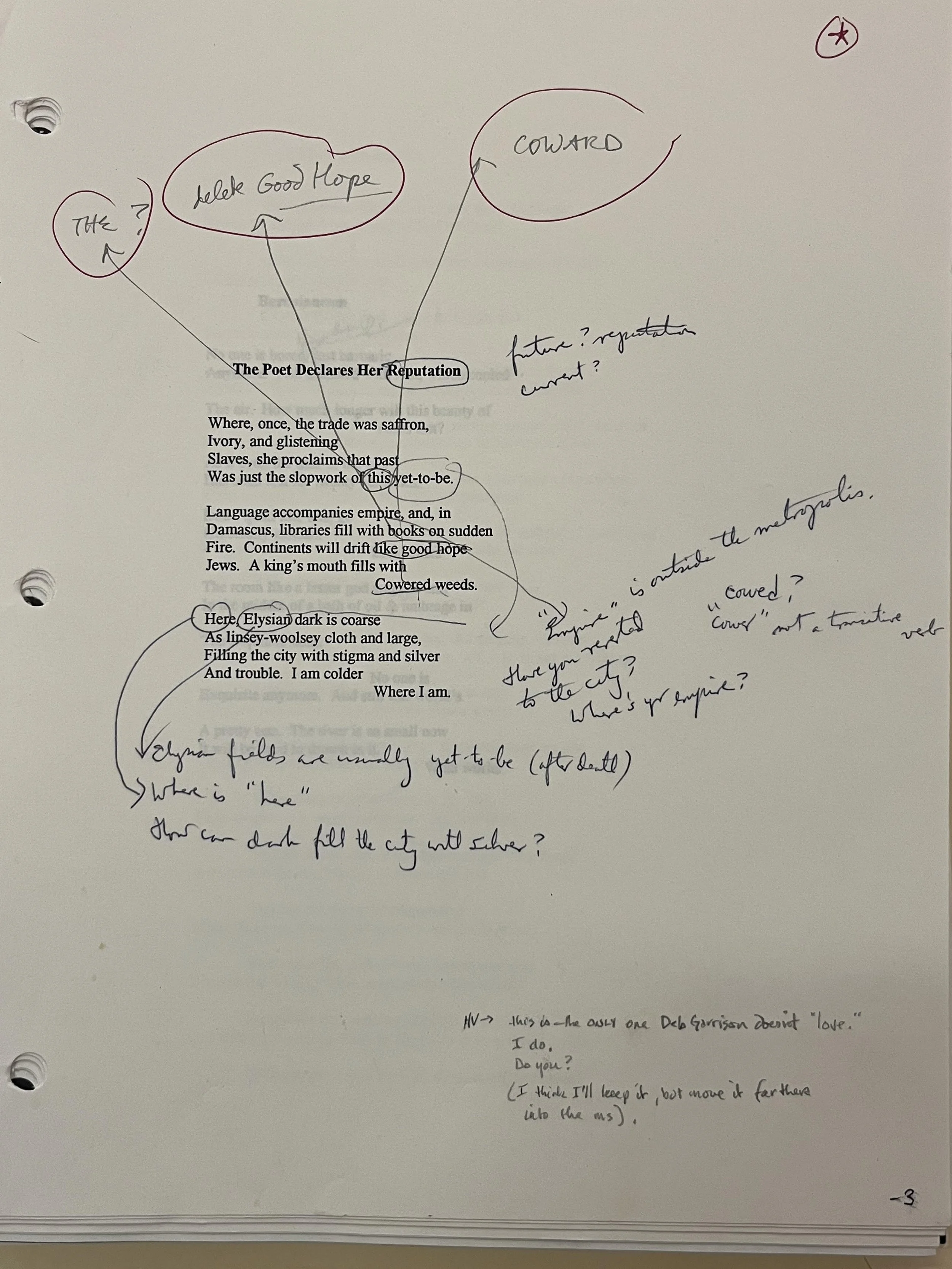
Early poem draft from what would eventually become Trouble in Mind
On August 8th, 1981, Lucie was admitted to a psychiatric hospital in Philadelphia. Her intake report reads: “pt unable to control her eating — compulsive eating — with depression — wandering — unable to settle — unwilling to return home + not knowing where she should go.” Separate from the psychiatric documents, I found tucked in an early journal a suicide note in Lucie’s handwriting. It was upsetting to read because I remembered experiencing similar feelings at that age; I felt tenderly toward the lost girls in our early twenties that both Lucie and I undoubtedly were. On the other hand, at age 30, I also felt a cringing sense of embarrassment at how unique we believed we were in our suffering. I talked to Timothy about the suicide note. He had already known about it and in fact mentioned the reaction of Binnie Kirschenbaum, a fellow Columbia teacher and close friend of Lucie. Binnie had been shocked that there was only one note, rather than dozens.
By all accounts, Lucie had an incredible sense of humor and dramatic flair. Timothy captured it best when he discussed Lucie’s ability to summon a “magical reality”; the way he put it was that Lucie recognized there was “no intrinsic meaning in the world and instead you must impart it and perform that meaning.” This followed with my impressions of Lucie post-archive visit: Lucie self-mythologized in an immensely self-aware way. This was evident especially in her voluminous correspondence, where she mimicked the syntax, tone, and capitalization of Emily Dickinson’s letters. At the time, Lucie was composing her second collection, The Master Letters, also inspired by Dickinson, but it was telling that Dickinson’s magic seeped into Lucie’s everyday communications with her editor and friends.
When it came to Lucie the line between myth and reality was always porous. While discussing Lucie’s immaculately designed home (there was a whole box in the archives devoted to her renovations), Timothy told me that Lucie had a bath faucet in the shape of a lion. He then immediately caveated to say that he might have invented that detail, just because it fit so perfectly in his schema of her. When I first typed those sentences, I had put in “gargoyle” because it fit so perfectly into my schema of her.
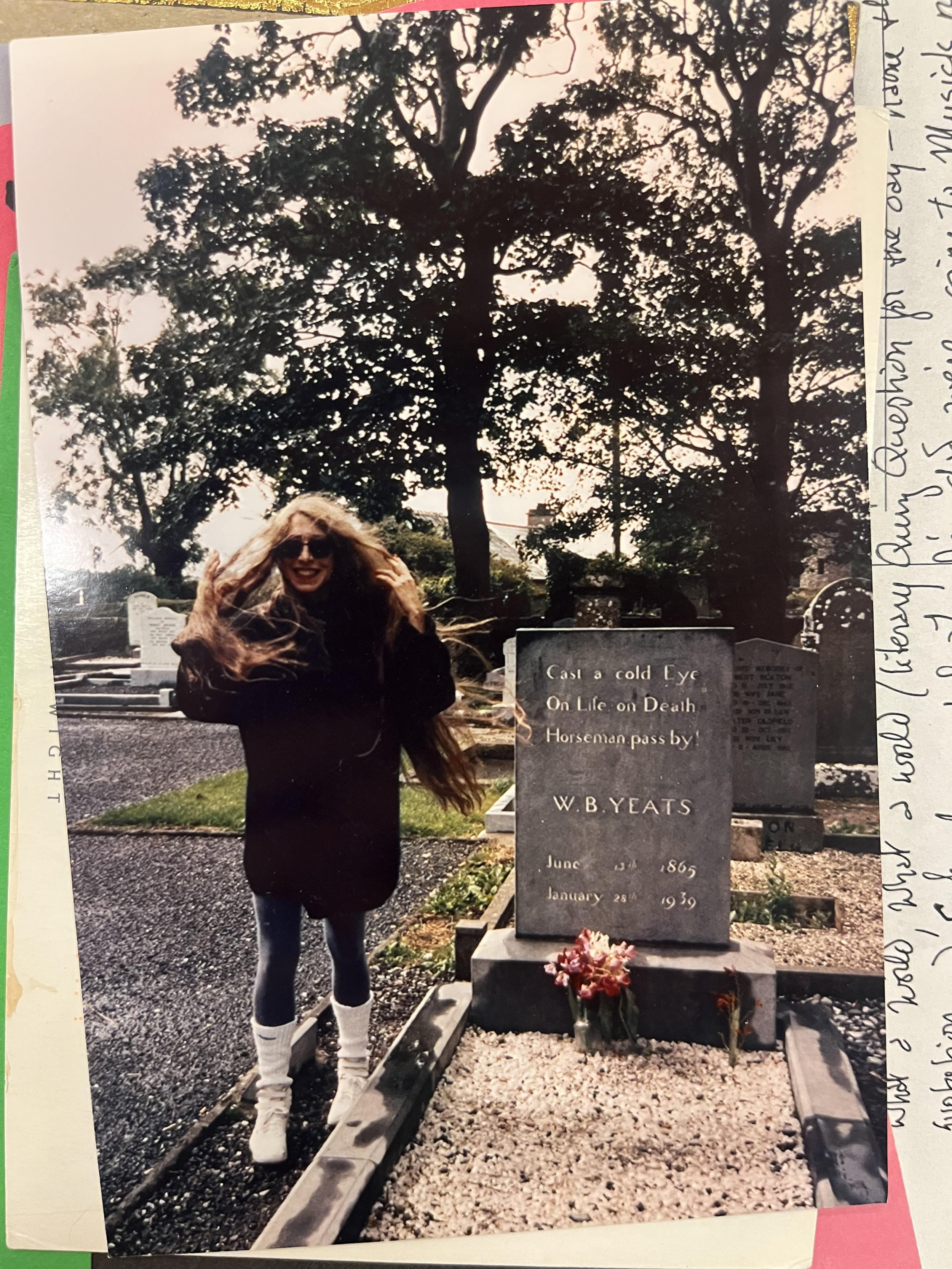
Lucie at Yeats’ grave.
Trouble In Mind takes inspiration from Wallace Stevens. Many of the poem titles in the collection are adapted from a list of titles Stevens made in his journals (71). Lucie also borrows another Stevens’ entry where he listed:
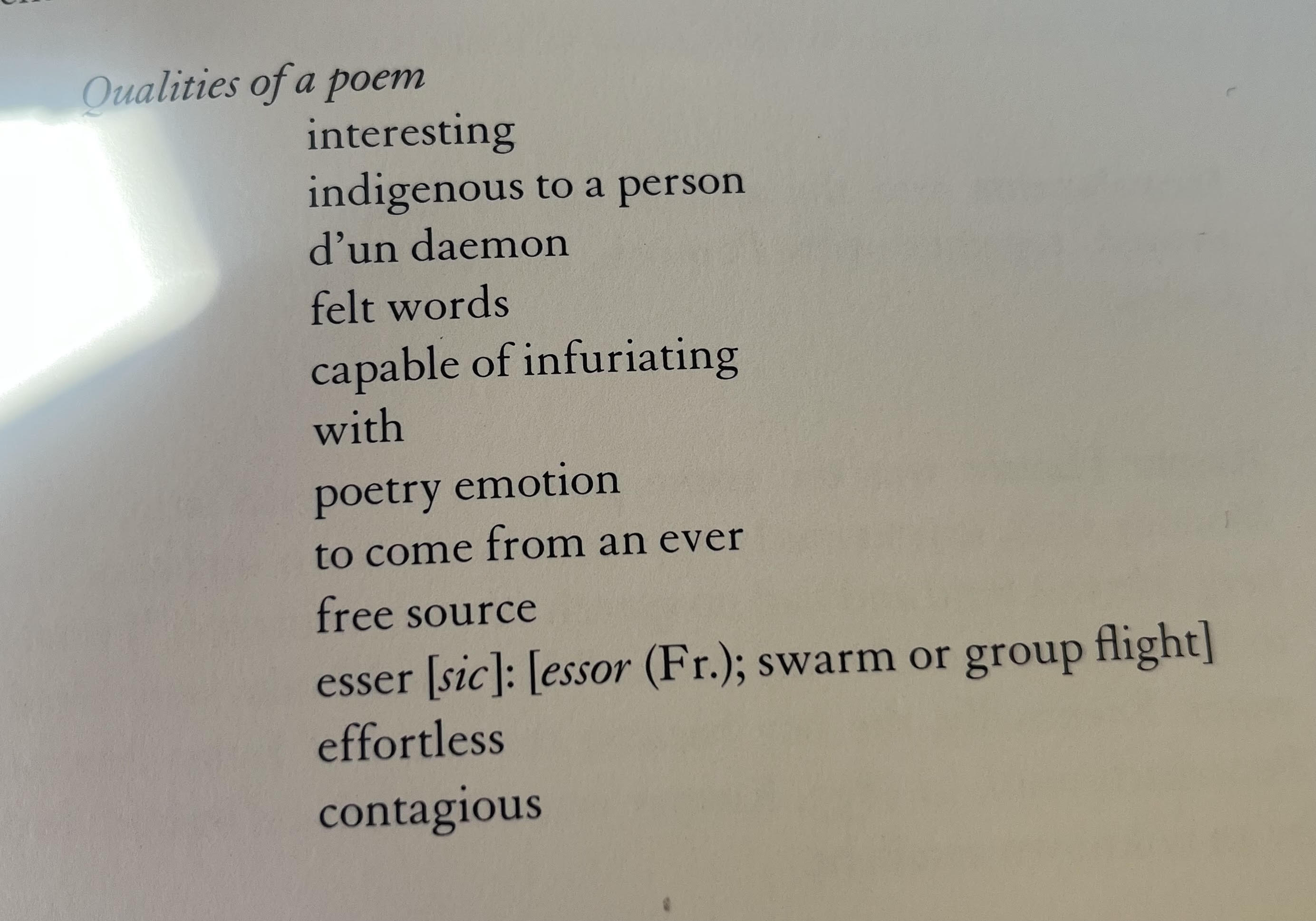
“Still Life with Aspirin” elaborates on the list’s eighth point:
For a poem to be true, it must ‘come from an Ever.’
If you don’t fathom that, then you should not be reading this.
I was there, at Ever, and it was mostly poignant and it was cruel.
Lucie transforms “ever” from an adverb into a noun, specifically a place, ambiguously described, or else defined by the speakers’ shifting attributes: “When I was there, at Ever, by the way, / I was an ascetic and unfanciful” (6). Ever is later described as: “peaceful as an aspirin, as the West Bank / Is an eternal circle of chalk and bruise and war” (6).
Aspirin, of course, is a common drug used to mitigate pain. Thus, “Ever” is a state of temporary oblivion, perhaps the most painful state in which to be. To know that the respite is fleeting means being hyperaware of the inevitability of pain’s return. The terror of understanding all things as temporary may be Lucie’s ultimate subject. It certainly animated the way she organized her life and preserved her things. One story Timothy told me is particularly relevant. He gave Lucie a block of peat incense from Ireland. Lucie never burned it, and when Timothy asked her why, she said that if she had, she would have lost the gift.
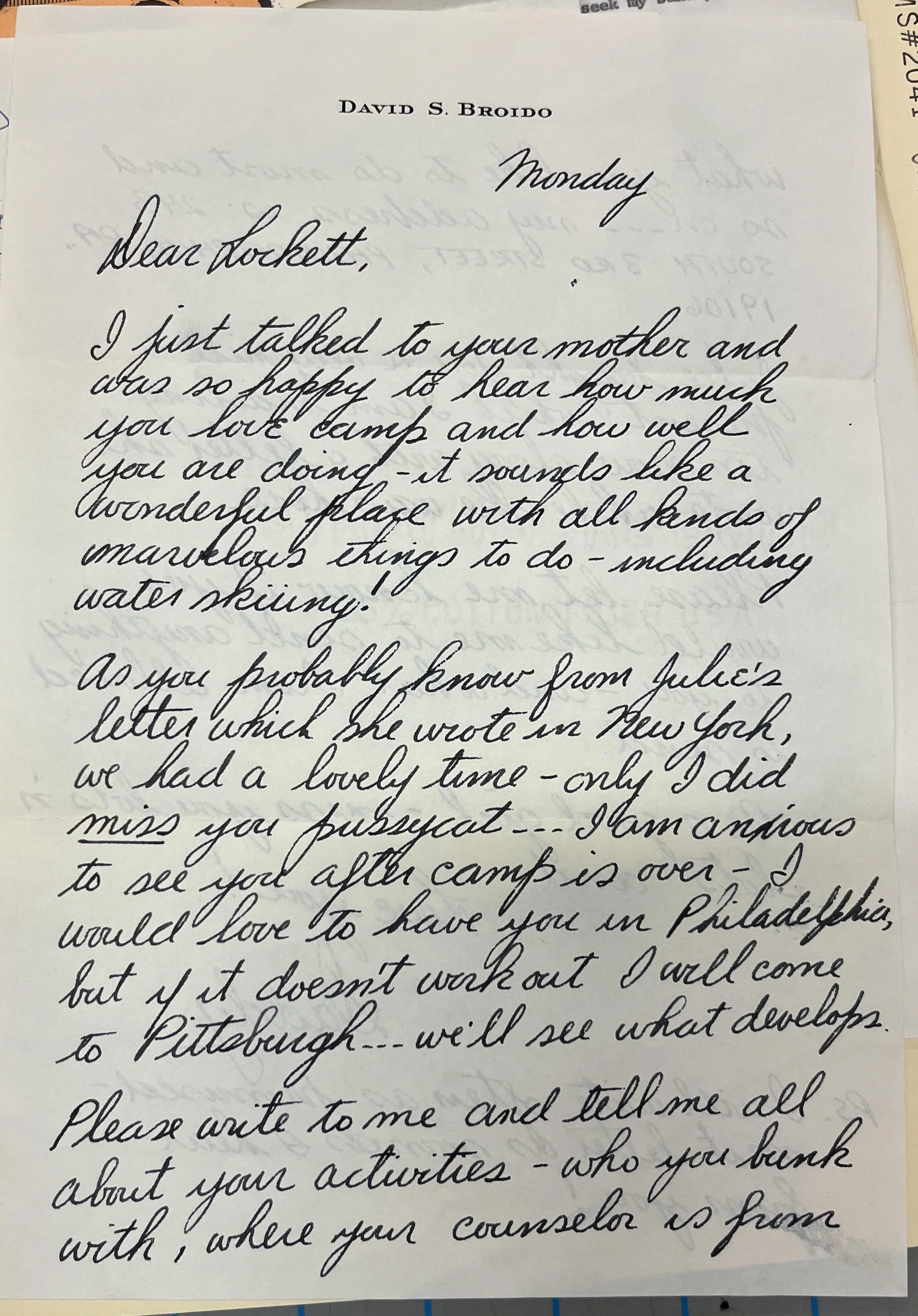
Letter from Lucie’s father, David Broido
Citations
Whewell, Esther. “Souvenir: Lucie Brock-Broido's True Kitsch.” Forms of Late Modernist Lyric, 2021, pp. 151-185.
Lucie Brock-Broido Papers; Rare Book and Manuscript Library, Columbia University Library.
Jamison, Leslie. The Empathy Exams : Essays. Graywolf Press, 2014.
Donnelly, Timothy. Personal Interview. 19 September, 2025.
Brock-Broido, Lucie. A Hunger. Knopf. 1988.
Smith, Tracy K. “Tracy K. Smith on Lucie Brock-Broido.” Women poets on mentorship : efforts and affections, edited by Arielle Greenberg and Rachel Zucker, University of Iowa Press, 2008, pp. 229-243.
—. Trouble in Mind. Knopf. 2004.
Margaret Saigh is the author of the chapbook I’ve created a thing that will never bring me pleasure (Pitymilk Press 2025) as well as two other chapbooks. She is the creator of circlet, a poetry workshop and reading series. Her writing has been published widely in print and across the web. She received an MFA from the University of Pittsburgh.